 ChipApex | Global Electronic Components Supplier

SEARCH
Search Product
Search Post
— IC芯片 | 连接器 | 传感器 | 被动器件 —
Search productSearch post
— IC芯片 | 连接器 | 传感器 | 被动器件 —
Consult the customer manager about the wholesale price.
consultation hotline:86-132-6715-2157
email:[email protected]
Contact the product manager for consultation. One-stop consultation is available.
Do you want a lower wholesale price? Please send us your inquiry and we will reply immediately.
The ADUM1233BRWZ-RL is a galvanically isolated precision half-bridge gate driver manufactured by Analog Devices Inc. It features two independent channels with a peak output current of 100mA and operates within an output supply voltage range of 12V to 18V. The device provides 2500Vrms isolation voltage and utilizes magnetic coupling technology for signal transmission. Key timing parameters include a rise time of 25ns, fall time of 25ns, and maximum propagation delay of 160ns. It supports a minimum supply voltage of 4.5V with nominal operating supply current of 3mA and power dissipation of 1W. The component is housed in a 16-lead SOIC package and functions across a temperature range of -40°C to +105°C.
Verify the specific suffix 'RL' indicates reel packaging configuration when sourcing. Confirm availability status as some distributors list limited stock or factory special orders. Ensure the 16-SOIC footprint matches the PCB layout requirements. Check that the 12V-18V output supply range aligns with the target gate driver voltage specifications. Validate RoHS compliance documentation for environmental regulations.
Select this component when a dual-channel isolated gate driver with 100mA peak current is required. Consider the 25ns rise/fall times for applications demanding moderate switching speeds. Verify that the 2500Vrms isolation barrier meets system safety standards. Ensure the 16-lead SOIC package fits the available board space. Compare against non-isolated drivers if isolation is not strictly necessary for cost reduction.
The ADUM1233 belongs to Analog Devices' ADuM family of iCoupler digital isolators. It integrates magnetic coupling technology on-chip to replace traditional optocouplers. This series offers improved performance in terms of speed, reliability, and size compared to legacy isolation methods. The BRWZ-RL variant specifically denotes the commercial temperature grade, SOIC package, and reel packaging format.
Public confirmed substitute part numbers are not provided in the source data.
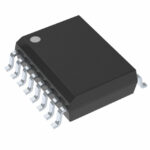 ADUM1233BRWZ-RL

The activity of extra discounts on wholesale prices is in full swing…
Please fill in your contact information and we will send you the latest wholesale price list.





