 ChipApex | Global Electronic Components Supplier
SEARCH
Search Product
Search Post
— IC芯片 | 连接器 | 传感器 | 被动器件 —
Search productSearch post
— IC芯片 | 连接器 | 传感器 | 被动器件 —
Consult the customer manager about the wholesale price.
consultation hotline:86-132-6715-2157
email:[email protected]
Contact the product manager for consultation. One-stop consultation is available.
Do you want a lower wholesale price? Please send us your inquiry and we will reply immediately.
The AFS600-1FG484K is a Field Programmable Gate Array from the Microsemi Fusion family, manufactured by Microchip Technology. It features 600,000 equivalent system gates and 13,824 configurable logic blocks (CLBs). The device utilizes a nonvolatile Flash-based CMOS process with a 130-nm technology node. It operates on a single 3.3 V supply with an internal 1.5 V regulator. The package is a 484-pin Plastic Ball Grid Array (PBGA) with a 1.0 mm pitch. The industrial temperature range extends from -40 °C to +100 °C. Maximum system performance reaches 350 MHz.
Verify the specific suffix 'K' against official Microchip documentation to confirm if it denotes a specific environmental rating or packaging variant distinct from standard commercial grades. Ensure compatibility with existing board layouts regarding the 484-pin BGA footprint and thermal requirements. Confirm RoHS compliance status through the manufacturer's current product change notices.
Select this component when nonvolatile configuration and mixed-signal integration are required within a high-density FPGA. Compare gate counts and I/O voltage levels against alternative Fusion family members like the M1AFS600 series. Evaluate the need for ARM core support; if processor integration is unnecessary, the pure logic AFS600 offers a simpler design path. Verify pin compatibility with legacy Actel designs if migrating existing projects.
This part belongs to the Actel Fusion family, bridging the gap between traditional Flash FPGAs and complex SoCs. It succeeds earlier ProASIC technologies while preceding the more integrated SmartFusion and IGLOO2 lines. The Fusion platform is characterized by its ability to embed analog peripherals directly into the programmable fabric, distinguishing it from purely digital FPGA competitors.
Direct pin-compatible replacements within the same package include other variants of the AFS600 series, such as the AFS600-1FG484I for industrial temperature ranges. Cross-family migration to the IGLOO2 or SmartFusion2 families requires schematic redesign due to architectural differences and pinout changes.
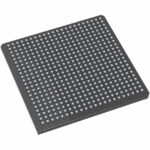 AFS600-1FG484K
The activity of extra discounts on wholesale prices is in full swing…
Please fill in your contact information and we will send you the latest wholesale price list.






