 ChipApex | Global Electronic Components Supplier
SEARCH
Search Product
Search Post
— IC芯片 | 连接器 | 传感器 | 被动器件 —
Search productSearch post
— IC芯片 | 连接器 | 传感器 | 被动器件 —
Consult the customer manager about the wholesale price.
consultation hotline:86-132-6715-2157
email:[email protected]
Contact the product manager for consultation. One-stop consultation is available.
Do you want a lower wholesale price? Please send us your inquiry and we will reply immediately.
The AGL250V5-VQG100I is an IGLOOe flash FPGA from Microchip Technology, utilizing a 130-nm process. It provides 250,000 system gates and 6,144 VersaTiles within a VQFP-100 package featuring 68 user I/Os. The device operates at a core voltage of 1.5 V (range 1.425 V to 1.575 V) with a maximum frequency of 892.86 MHz. It supports industrial temperature ranges (-40°C to +85°C), includes 36,864 bits of total SRAM, and incorporates Flash*Freeze technology for ultra-low power retention.
Verify component authenticity through authorized Microchip distributors or direct channels. Confirm the specific V5 revision marking on the device surface matches the ordered part number. Ensure proper handling procedures are followed due to moisture sensitivity classification requirements during storage and assembly.
Select this model when 250,000 system gates and 68 user I/Os are required in a VQFP-100 package. Choose this variant over ARM-enabled M1AGL devices if cryptographic AES decryption is needed, as ARM versions lack this feature. Verify that the 1.5 V only core voltage specification meets the target system power constraints.
This component belongs to the IGLOOe family, representing an evolution of the original IGLOO flash FPGA line. It maintains architectural compatibility with previous generations while offering enhanced performance metrics. The V5 suffix indicates a specific manufacturing revision within the broader AGL250 product series.
Direct pin-compatible replacements within the same package include other AGL250 variants such as AGL250V2-VQG100I. Cross-family migration to ProASIC3 devices like A3P250-VQG100I requires significant design adaptation due to differing logic architectures and memory structures.
Yes, standard IGLOO devices like the AGL250V5 support AES-128 decryption for secure in-system programming. This feature is not available in ARM-enabled M1IGLOO devices.
Flash*Freeze allows the device to enter an ultra-low power mode consuming as little as 5 µW while retaining all configuration data, SRAM content, and register states without reloading from external memory.
Yes, the nonvolatile flash configuration memory is immune to firm errors caused by high-energy neutrons, unlike SRAM-based FPGAs which may experience unpredictable logic changes.
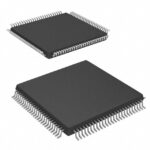 AGL250V5-VQG100I
The activity of extra discounts on wholesale prices is in full swing…
Please fill in your contact information and we will send you the latest wholesale price list.





