ChipApex | Global Electronic Components Supplier
SEARCH
Search Product
Search Post
— IC芯片 | 连接器 | 传感器 | 被动器件 —
Search productSearch post
— IC芯片 | 连接器 | 传感器 | 被动器件 —
Consult the customer manager about the wholesale price.
consultation hotline:86-132-6715-2157
email:[email protected]
Contact the product manager for consultation. One-stop consultation is available.
Do you want a lower wholesale price? Please send us your inquiry and we will reply immediately.
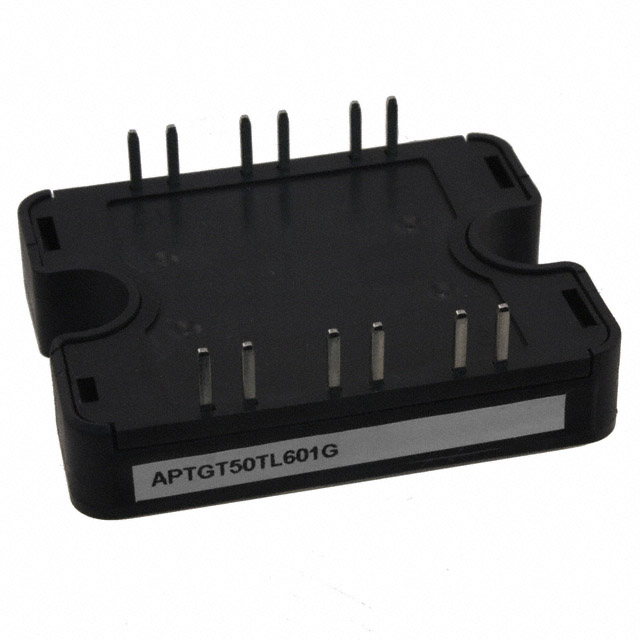
The APTGT50TL601G is a silicon IGBT module manufactured by Microchip Technology, designed for three-phase inverter configurations. It utilizes Trench Field-Stop technology within an SP1-12 screw-mount package. The device supports a maximum collector-emitter voltage of 600 V and delivers a continuous collector current of 80 A at 25°C. Key electrical characteristics include a collector-emitter saturation voltage of 1.5 V, a gate-emitter leakage current of 600 nA, and a power dissipation rating of 176 W. The module operates within a temperature range of -40°C to +100°C, with a maximum gate-emitter voltage of 20 V.
Verify the specific suffix 'G' against official Microchip documentation to confirm RoHS compliance status, as datasheet references may vary. Confirm the active manufacturing status and lead times directly with authorized distributors or the manufacturer, as supply chain conditions fluctuate. Ensure the SP1-12 package dimensions match the target thermal interface design before procurement.
Select this component when a 600 V rated, 80 A continuous current capability is required for three-phase topologies. The SP1-12 package suits applications needing screw-mount integration with moderate power density. Compare the 1.5 V saturation voltage against system efficiency targets. Verify that the operating junction temperature limits align with the intended thermal management strategy for the specific application environment.
This part belongs to the APTGT series of IGBT modules from Microchip Technology, which focuses on trench field-stop technologies. It shares the SP1-12 package form factor with other variants in the lineup, such as the APTGT20TL601G, but offers higher current handling capabilities. The series is designed for industrial power electronics requiring reliable three-phase inversion.
The APTGT20TL601G is a verified substitute within the same package family, offering identical pinout and mechanical dimensions but with a lower 32 A current rating. Ensure the reduced current capacity meets the specific load requirements of the circuit before substitution.
 APTGT50TL601G
The activity of extra discounts on wholesale prices is in full swing…
Please fill in your contact information and we will send you the latest wholesale price list.