 ChipApex | Global Electronic Components Supplier
SEARCH
Search Product
Search Post
— IC芯片 | 连接器 | 传感器 | 被动器件 —
Search productSearch post
— IC芯片 | 连接器 | 传感器 | 被动器件 —
Consult the customer manager about the wholesale price.
consultation hotline:86-132-6715-2157
email:[email protected]
Contact the product manager for consultation. One-stop consultation is available.
Do you want a lower wholesale price? Please send us your inquiry and we will reply immediately.
The AS2523-T is a CMOS integrated circuit designed for A/B-line powered telephony applications, featuring a serial interface and enhanced voice switching capabilities. It incorporates DC and AC line adaptation with synthesized AC-impedance of 1000 ohms, speech circuits with softclipping, and line loss compensation. The device supports handset and handsfree operation, offering programmable Tx/Rx gain and digital volume control via its serial interface. Operating currents range from 15mA to 100mA in normal mode, or 5mA to 15mA with reduced performance. It is available in a 28-pin SOIC package.
Verify the specific suffix 'T' corresponds to the 28-pin plastic SOIC surface-mounted package as listed in the ordering information. Confirm that the serial interface requirement aligns with the AS2523 variant rather than the parallel interface variants (AS2524/2524B). Ensure compatibility with the required operating current range and voltage levels specified in the datasheet.
Select the AS2523-T when a microcontroller-based serial interface is preferred for flexible gain and volume programming. Choose this variant over AS2524/2524B if line loss compensation needs to be programmable rather than fixed. Consider the 28-pin SOIC package constraints and ensure sufficient board space for the required external components for impedance and side tone adjustment.
The AS2523 is part of the AS2523/24 family developed by austriamicrosystems AG (now ams AG). It shares the same die with the AS2524 and AS2524B models, differing primarily in interface type and feature activation. The AS2523 specifically enables full software configurability through its serial port, distinguishing it from the hardware-configured parallel interface counterparts.
Public confirmed substitute part numbers are not provided in the source material. The AS2523 shares the same die as AS2524 and AS2524B; however, interface differences (Serial vs. Parallel) and feature variations (programmable LLC vs. fixed) must be evaluated before considering cross-model substitution.
On the AS2523, Line Loss Compensation is programmable via the serial interface registers. In contrast, it is not activated on the AS2524 and is permanently activated at high threshold on the AS2524B.
The default setting after power-up is handset mode. The register contents are lost if VDD drops, so registers must be re-written after each hook event or power-up.
Yes, the AS2523 allows programmable Tx and Rx gain adjustments via its serial interface registers, whereas the AS2524/2524B have fixed default gains unless modified by hardware bonding options.
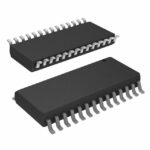 AS2523-T
The activity of extra discounts on wholesale prices is in full swing…
Please fill in your contact information and we will send you the latest wholesale price list.




