 ChipApex | Global Electronic Components Supplier
SEARCH
Search Product
Search Post
— IC芯片 | 连接器 | 传感器 | 被动器件 —
Search productSearch post
— IC芯片 | 连接器 | 传感器 | 被动器件 —
Consult the customer manager about the wholesale price.
consultation hotline:86-132-6715-2157
email:[email protected]
Contact the product manager for consultation. One-stop consultation is available.
Do you want a lower wholesale price? Please send us your inquiry and we will reply immediately.
The ATA6561-GAQW-N is a high-speed CAN transceiver manufactured by Microchip Technology, designed for automotive and industrial applications. It supports communication speeds up to 5 Mbps and complies with ISO 11898-2, ISO 11898-5, and SAE J2284 standards. The device operates within a supply voltage range of 4.5V to 5.5V on the VCC pin and features a dedicated VIO pin (Pin 5) that allows direct interfacing with microcontrollers operating at 3.3V or 5V. It includes Standby mode with remote wake-up capability via the CAN bus. The component is qualified according to AEC-Q100 and housed in an 8-lead SOIC package.
Verify the specific ordering suffix '-N' corresponds to the required package type and compliance specifications. Confirm that the VIO pin configuration aligns with the target microcontroller's supply voltage requirements. Ensure that the design accounts for the undervoltage detection thresholds on both VCC and VIO pins to maintain reliable operation under varying power conditions.
Select the ATA6561-GAQW-N when direct interfacing with 3.3V logic is required, as the VIO pin adjusts signal levels accordingly. Choose this variant over the ATA6560 if Silent Mode is not needed, as the ATA6561 lacks the NSIL control input. Consider the thermal performance of the SOIC package and ensure adequate PCB layout for heat dissipation during dominant transmission states.
The ATA6561-GAQW-N belongs to the ATA6560/1 family of high-speed CAN transceivers from Microchip Technology. This family is distinguished by its ability to operate in Normal, Standby, and Unpowered modes, with the ATA6561 specifically offering a VIO pin for versatile microcontroller integration. The '-N' suffix typically denotes specific packaging or compliance variations within the product line.
The ATA6561-GBQW serves as a package alternative in the same functional family, offering a VDFN8 option instead of SOIC8. Both variants share identical electrical characteristics and pin functions regarding the VIO pin. Verify that the chosen replacement matches the mechanical footprint and thermal requirements of the existing design.
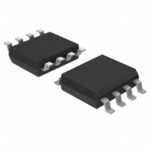 ATA6561-GAQW-N
The activity of extra discounts on wholesale prices is in full swing…
Please fill in your contact information and we will send you the latest wholesale price list.