 ChipApex | Global Electronic Components Supplier
SEARCH
Search Product
Search Post
— IC芯片 | 连接器 | 传感器 | 被动器件 —
Search productSearch post
— IC芯片 | 连接器 | 传感器 | 被动器件 —
Consult the customer manager about the wholesale price.
consultation hotline:86-132-6715-2157
email:[email protected]
Contact the product manager for consultation. One-stop consultation is available.
Do you want a lower wholesale price? Please send us your inquiry and we will reply immediately.
The ATF1504AS-10JC44 is a high-performance, electrically-erasable Complex Programmable Logic Device (CPLD) manufactured by Microchip Technology. It features 64 macrocells with up to 40 product terms per macrocell via expandable logic chains. The device supports In-System Programmability (ISP) via the JTAG interface and offers flexible I/O configurations with 3.3V or 5.0V compatibility. Key electrical parameters include a maximum pin-to-pin delay of 10 ns for the -10 speed grade, registered operation frequencies up to 125 MHz, and EEPROM-based non-volatile storage allowing 10,000 program/erase cycles. It operates within commercial temperature ranges.
Verify the specific ordering suffix against official Microchip documentation to confirm package type and temperature range. The 'JC' suffix typically denotes a PLCC-44 package in commercial temperature range, but datasheet cross-referencing is required as suffixes define physical attributes rather than functional changes. Ensure design files account for the specific pinout of the 44-lead PLCC configuration.
Select the -10 speed grade when a maximum pin-to-pin delay of 10 ns is required. Consider the ATF1504ASL variant if automatic microamp standby mode is needed for low-power applications. Verify that the design utilizes the available global clock pins and output enable signals efficiently, as these are critical for high-speed registered operations up to 125 MHz.
This component belongs to the ATF1504AS/L family of high-density CPLDs. It shares architectural similarities with other variants in the series, such as the ATF1504AS-10JC84 (84-pin PLCC) and ATF1504AS-10AU44-T (44-lead TQFP), differing primarily in package footprint and pin count while maintaining identical core logic resources and performance characteristics.
Direct pin-compatible replacements within the same package require matching the speed grade and voltage requirements. Variants like ATF1504AS-7JC44 offer faster speeds (7.5 ns delay). For different packages, logical equivalents must be mapped manually due to pinout differences.
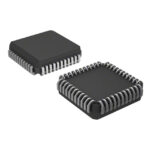 ATF1504AS-10JC44
The activity of extra discounts on wholesale prices is in full swing…
Please fill in your contact information and we will send you the latest wholesale price list.





