 ChipApex | Global Electronic Components Supplier
SEARCH
Search Product
Search Post
— IC芯片 | 连接器 | 传感器 | 被动器件 —
Search productSearch post
— IC芯片 | 连接器 | 传感器 | 被动器件 —
Consult the customer manager about the wholesale price.
consultation hotline:86-132-6715-2157
email:[email protected]
Contact the product manager for consultation. One-stop consultation is available.
Do you want a lower wholesale price? Please send us your inquiry and we will reply immediately.
The BA1604 is a PLL tone decoder IC from ROHM Semiconductor. It integrates a PLL circuit, detection circuit, voltage comparator, and output logic drive. The center frequency (f0) is set by external components on Pins 5 and 6. When the input signal locks to the PLL, the decoder output drops, activating the drive transistors. It supports a load current of up to 100mA. Recommended operating conditions include a supply voltage (VCC) of 5V. Absolute maximum ratings specify limits for supply voltage and power dissipation at Ta=25°C.
Verify the specific package type and suffix against the official datasheet before ordering. Confirm RoHS compliance status if required by your manufacturing standards. Ensure the supplier provides genuine ROHM Semiconductor products to avoid counterfeit components. Check for any specific handling or storage requirements mentioned in the manufacturer's documentation.
Select the BA1604 when precise tone decoding via PLL synchronization is required. Ensure the application demands a load capacity of up to 100mA. Verify that the required center frequency can be established using the recommended resistor and capacitor values on Pins 5 and 6. Consider compatibility with existing NE567 designs if migrating from legacy parts.
The BA1604 belongs to ROHM's Communication ICs category, specifically designed as a tone decoder. It serves as a functional replacement for older tone decoder architectures, offering integrated PLL technology for improved frequency selection precision compared to basic filter-based decoders.
The datasheet explicitly lists compatibility with EXAR XR-567 and Signetics NE567. These are confirmed pin-compatible or functionally equivalent alternatives for design migration purposes.
The center frequency is set by the resistor R1 connected between Pins 5 and 6, and the capacitor C1 connected between Pin 6 and ground.
Capacitor C3 acts as an output filter connected between Pin 1 and ground to suppress out-of-band signals and prevent false detection of spurious signals.
Internal circuits set the input pin (Pin 3) to a DC potential of 2V with respect to ground.
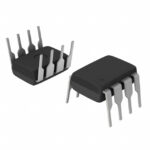 BA1604
The activity of extra discounts on wholesale prices is in full swing…
Please fill in your contact information and we will send you the latest wholesale price list.





