 ChipApex | Global Electronic Components Supplier
SEARCH
Search Product
Search Post
— IC芯片 | 连接器 | 传感器 | 被动器件 —
Search productSearch post
— IC芯片 | 连接器 | 传感器 | 被动器件 —
Consult the customer manager about the wholesale price.
consultation hotline:86-132-6715-2157
email:[email protected]
Contact the product manager for consultation. One-stop consultation is available.
Do you want a lower wholesale price? Please send us your inquiry and we will reply immediately.
The BAT54C-AQ is a Schottky barrier diode array manufactured by Diotec Semiconductor, housed in an SOT-23 surface-mount package. It features two common cathode elements with a maximum repetitive peak reverse voltage of 30 V and an average forward rectifying current of 200 mA per diode. The device exhibits a low forward voltage drop of approximately 1 V at 100 mA and a fast switching speed characterized by a reverse recovery time of 5 ns. Designed for automotive reliability, it operates within a junction temperature range of -55°C to 150°C and complies with AEC-Q101 standards.
Verify the specific ordering code suffix to confirm the presence of the automotive grade designation and ensure compliance with AEC-Q101 requirements. Confirm that the requested quantity matches the standard tape and reel packaging specifications provided by the manufacturer. Cross-reference the component marking codes on the physical devices to validate authenticity and traceability before finalizing procurement orders.
Select this component when designing systems requiring robust reverse polarity protection or fast signal steering in automotive environments. The common cathode configuration simplifies schematic design for dual-diode applications. Ensure the thermal management strategy accommodates the power dissipation limits specified in the datasheet to maintain performance within the extended operating temperature range.
This part belongs to the BAT54 series of small-signal Schottky diodes, widely utilized in consumer electronics and industrial applications. The 'AQ' suffix specifically denotes the automotive qualified variant, distinguishing it from standard commercial versions. It serves as a critical passive component in modern vehicle electronics, supporting functions ranging from battery management to infotainment system protection.
Direct substitutes include other automotive-qualified Schottky arrays in SOT-23 packages, such as the BAT54S-AQ or BAT54A-AQ from Diotec, provided pin configurations and electrical parameters align with the original design requirements.
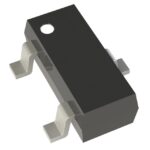 BAT54C-AQ
The activity of extra discounts on wholesale prices is in full swing…
Please fill in your contact information and we will send you the latest wholesale price list.





