 ChipApex | Global Electronic Components Supplier
SEARCH
Search Product
Search Post
— IC芯片 | 连接器 | 传感器 | 被动器件 —
Search productSearch post
— IC芯片 | 连接器 | 传感器 | 被动器件 —
Consult the customer manager about the wholesale price.
consultation hotline:86-132-6715-2157
email:[email protected]
Contact the product manager for consultation. One-stop consultation is available.
Do you want a lower wholesale price? Please send us your inquiry and we will reply immediately.
The BAT54CTT1G is a dual common cathode Schottky barrier diode manufactured by onsemi. It utilizes silicon technology and is housed in an SOT-323 (SC-70) surface-mount package with three pins. The device features a maximum repetitive reverse voltage of 30 V and a continuous forward current rating of 100 mA. Key electrical parameters include a maximum forward voltage of 520 mV, a peak non-repetitive forward surge current of 600 mA, and a maximum reverse current of 2 uA. It operates within a temperature range of -55 C to +125 C with a power dissipation of 200 mW.
Verify the specific suffix TT1G against official onsemi documentation to confirm packaging details such as tape and reel specifications. Ensure the component meets RoHS compliance requirements for your manufacturing process. Cross-reference the datasheet revision to validate thermal resistance and maximum ratings before finalizing procurement orders.
Select this component when a low-profile dual Schottky diode is required for portable or handheld electronics. The SOT-323 package offers a compact footprint ideal for dense PCB layouts. Consider the 30 V reverse voltage limit and 100 mA current capacity to ensure adequate headroom for the target application's electrical demands.
This part belongs to the BAT54CW series of Schottky barrier diodes from onsemi. These devices are designed for high-speed switching and clamping applications where low forward voltage is critical. The series is widely used in consumer electronics and communication equipment due to its reliability and small form factor.
BAT54CT1G
The device contains two Schottky diodes connected in a common cathode configuration within a single three-pin package.
Yes, the BAT54CW series is AEC-Q101 qualified and PPAP capable, making it suitable for automotive and other demanding environments requiring unique site and control change requirements.
The device is designed for high-speed switching applications, featuring extremely fast switching speeds inherent to Schottky barrier technology.
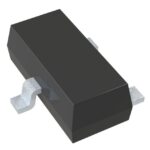 BAT54CTT1G
The activity of extra discounts on wholesale prices is in full swing…
Please fill in your contact information and we will send you the latest wholesale price list.





