 ChipApex | Global Electronic Components Supplier
SEARCH
Search Product
Search Post
— IC芯片 | 连接器 | 传感器 | 被动器件 —
Search productSearch post
— IC芯片 | 连接器 | 传感器 | 被动器件 —
Consult the customer manager about the wholesale price.
consultation hotline:86-132-6715-2157
email:[email protected]
Contact the product manager for consultation. One-stop consultation is available.
Do you want a lower wholesale price? Please send us your inquiry and we will reply immediately.
BAT54S-7-F-2477 is a dual Schottky barrier diode array manufactured by Diodes Incorporated. It features a common cathode configuration with two independent silicon elements integrated into a single SOT-23 surface-mount package. The device supports a maximum repetitive peak reverse voltage of 30 V and an average forward rectified current of 200 mA per diode. Key electrical characteristics include a low forward voltage drop, minimal reverse leakage current, and ultra-fast switching capabilities with a reverse recovery time typically under 5 ns. The component operates within a junction temperature range of -65 °C to +150 °C and dissipates up to 350 mW of power.
Verify the specific ordering suffix against manufacturer documentation to confirm pinout compatibility and packaging specifications. Ensure the selected variant matches the required thermal dissipation and voltage ratings for the target application environment. Cross-reference datasheet parameters with system requirements before finalizing procurement decisions.
Select this component when a small form factor is required for dual Schottky applications. The common cathode arrangement simplifies PCB routing compared to discrete solutions. Evaluate thermal constraints carefully, as the SOT-23 package has limited heat dissipation capacity. Confirm that the 30 V reverse voltage rating exceeds the maximum expected circuit voltage including transients.
The BAT54S belongs to a widely used family of small-signal Schottky diodes designed for high-efficiency rectification and switching. Variants within the series differ primarily in internal connection schemes, such as common anode or series configurations. This specific model represents the common cathode version, distinguishing it from other BAT54 derivatives like the BAT54A or BAT54C.
Compatible substitutes include BAT54S from other manufacturers such as ON Semiconductor or Vishay, provided they adhere to the same SOT-23 footprint and electrical specifications. Verify pinout alignment and thermal characteristics before substitution.
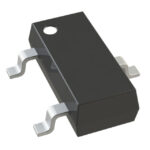 BAT54S-7-F-2477
The activity of extra discounts on wholesale prices is in full swing…
Please fill in your contact information and we will send you the latest wholesale price list.





