 ChipApex | Global Electronic Components Supplier

SEARCH
Search Product
Search Post
— IC芯片 | 连接器 | 传感器 | 被动器件 —
Search productSearch post
— IC芯片 | 连接器 | 传感器 | 被动器件 —
Consult the customer manager about the wholesale price.
consultation hotline:86-132-6715-2157
email:[email protected]
Contact the product manager for consultation. One-stop consultation is available.
Do you want a lower wholesale price? Please send us your inquiry and we will reply immediately.
The BAT54SW is a small signal Schottky diode manufactured by Diotec Semiconductor in the SOT-323-3 surface-mount package. It features a dual series configuration with a maximum repetitive peak reverse voltage of 30 V and an average forward current rating of 200 mA. The device exhibits a low forward voltage drop, reaching up to 1000 mV at 100 mA, and maintains a maximum reverse leakage current of 3 µA at 30 V. Key electrical characteristics include a peak forward surge current of 600 mA, a maximum junction capacitance of 10 pF, and a reverse recovery time under 5 ns. The component operates within a junction temperature range of -55°C to +150°C.
Verify the specific manufacturer part number against official datasheets to confirm exact electrical tolerances and packaging specifications. Ensure compliance with RoHS directives and confirm the required moisture sensitivity level for your assembly process. Cross-reference thermal resistance values with your board layout copper pad dimensions to validate power dissipation capabilities under operating conditions.
Select this component when a low-capacitance Schottky diode is required for high-frequency signal paths. The dual series configuration allows for compact designs compared to discrete single-diode solutions. Evaluate the forward voltage requirements at your specific operating current to ensure compatibility with downstream logic levels or power constraints.
This component belongs to the BAT54W family of small signal Schottky diodes produced by Diotec Semiconductor. The family includes variants such as BAT54AW and BAT54CW, which share similar physical footprints but may differ in specific forward voltage or leakage characteristics. These devices are standard commercial-grade components designed for general-purpose electronic applications.
BAT54S-AQ
The maximum junction capacitance is specified as 10 pF at 0 V reverse bias and 1 MHz frequency.
The reverse recovery time is less than 5 ns, enabling the device to operate effectively in high-speed switching applications with minimal delay.
The typical thermal resistance from junction to ambient is 620 K/W when mounted on a printed circuit board with 3 mm² copper pads at each terminal.
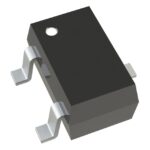 BAT54SW

The activity of extra discounts on wholesale prices is in full swing…
Please fill in your contact information and we will send you the latest wholesale price list.





