 ChipApex | Global Electronic Components Supplier

SEARCH
Search Product
Search Post
— IC芯片 | 连接器 | 传感器 | 被动器件 —
Search productSearch post
— IC芯片 | 连接器 | 传感器 | 被动器件 —
Consult the customer manager about the wholesale price.
consultation hotline:86-132-6715-2157
email:[email protected]
Contact the product manager for consultation. One-stop consultation is available.
Do you want a lower wholesale price? Please send us your inquiry and we will reply immediately.
The BAT54TB6-AU is a Schottky barrier rectifier manufactured by Panjit International Inc. in an SOT-563 package. It features a maximum repetitive peak reverse voltage of 30 V and a maximum average forward current of 0.2 A. The device supports a peak forward surge current of 0.6 A for a single half-sine wave lasting one second. Electrical characteristics include a maximum forward voltage of 0.6 V at 100 mA and a typical junction capacitance of 4 pF measured at 1 MHz. The component operates within a junction temperature range of -55°C to 125°C.
Verify the specific ordering suffix matches the required packaging configuration, as standard reels may differ from cut tape or mouse reel quantities. Confirm that the AEC-Q101 qualification status aligns with your target application's regulatory requirements. Ensure the SOT-563 footprint matches your PCB design guidelines before finalizing procurement orders.
Select this component when a compact dual-diode solution is needed in an SOT-563 package. The 30 V rating suits low-voltage DC circuits, while the 0.2 A current capacity handles moderate loads. Consider the low forward voltage for efficiency-critical designs. Verify thermal resistance limits against your ambient temperature conditions to ensure safe operation within the specified junction temperature range.
This part belongs to the BAT54 series of Schottky barrier rectifiers produced by Panjit. The series utilizes silicon technology to provide fast switching speeds and negligible reverse recovery time. The SOT-563 package allows for automated placement, making it suitable for high-volume manufacturing processes where board space is limited.
Cross-reference with other SOT-563 Schottky diodes rated for 30 V and 0.2 A. Verify pinout compatibility and electrical parameters such as forward voltage and reverse leakage current before substitution.
The maximum operating junction temperature is 125°C.
Yes, the BAT54TB6-AU is AEC-Q101 qualified.
The typical junction capacitance is 4 pF, measured at 1 MHz with an applied reverse voltage of 4 V.
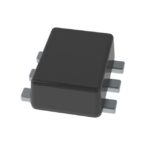 BAT54TB6-AU_R1_000A1

The activity of extra discounts on wholesale prices is in full swing…
Please fill in your contact information and we will send you the latest wholesale price list.





