 ChipApex | Global Electronic Components Supplier

SEARCH
Search Product
Search Post
— IC芯片 | 连接器 | 传感器 | 被动器件 —
Search productSearch post
— IC芯片 | 连接器 | 传感器 | 被动器件 —
Consult the customer manager about the wholesale price.
consultation hotline:86-132-6715-2157
email:[email protected]
Contact the product manager for consultation. One-stop consultation is available.
Do you want a lower wholesale price? Please send us your inquiry and we will reply immediately.
The BAT721AC_R1_00001 is a double Schottky barrier diode manufactured by Panjit International Inc. It features a maximum repetitive peak reverse voltage of 40 V and a maximum average forward current of 0.4 A per diode. The device utilizes a SOT-23 plastic package with an approximate weight of 0.0084 grams. Electrical characteristics include a typical junction capacitance of 7 pF measured at 1 MHz and a thermal resistance of 350 °C/W per diode. Forward voltage ranges from 0.45 V to 0.65 V depending on current, while reverse current is specified up to 50 µA at 40 V.
Verify the specific ordering suffix R1_00001 against official Panjit documentation to confirm packaging quantity and tape-and-reel specifications. Ensure compliance with RoHS 2.0 and IEC 61249 green molding compound standards as stated in the datasheet. Confirm that the SOT-23 package dimensions match your PCB footprint requirements before finalizing procurement orders.
Select this component when dual Schottky configurations are required within a compact SOT-23 footprint. The 40 V rating and 0.4 A current capacity suit low-voltage signal processing tasks. Consider the 7 pF junction capacitance for high-frequency performance needs. Verify thermal management capabilities given the 350 °C/W thermal resistance per diode under standard mounting conditions.
This part belongs to the PBAT721AC series of double Schottky barrier diodes produced by Panjit International Inc. The series is designed for surface-mount technology applications requiring fast switching and low forward voltage. The BAT721AC variant specifically integrates two diodes in a single SOT-23 package, offering a compact solution for dual-channel rectification or clamping functions in modern electronic assemblies.
Cross-reference with Nexperia BAT721A,215 for similar SOT-23 dual Schottky specifications. Verify electrical parameter compatibility, particularly forward voltage and reverse leakage current, before substitution. Ensure pinout configuration matches exactly to prevent circuit damage during replacement.
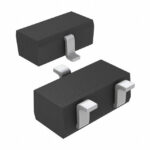 BAT721AC_R1_00001

The activity of extra discounts on wholesale prices is in full swing…
Please fill in your contact information and we will send you the latest wholesale price list.





