 ChipApex | Global Electronic Components Supplier
SEARCH
Search Product
Search Post
— IC芯片 | 连接器 | 传感器 | 被动器件 —
Search productSearch post
— IC芯片 | 连接器 | 传感器 | 被动器件 —
Consult the customer manager about the wholesale price.
consultation hotline:86-132-6715-2157
email:[email protected]
Contact the product manager for consultation. One-stop consultation is available.
Do you want a lower wholesale price? Please send us your inquiry and we will reply immediately.
The BAV18-TR is a silicon epitaxial planar switching diode from Vishay Semiconductors, designed for high-voltage general-purpose applications. It features a repetitive peak reverse voltage of 60 V and a maximum forward continuous current of 250 mA. The device operates within a junction temperature range of -55 °C to +175 °C and dissipates up to 500 mW. Packaged in the DO-35 (DO-204AH) axial leaded format with a black cathode band, it offers low capacitance of 1.5 pF and a reverse recovery time of 50 ns.
Verify that the specific ordering code matches the required packaging option, as the datasheet lists both tape-and-reel (TR) and ammopack (TAP) variants. Confirm compliance requirements against the material categorization document referenced in the official specifications. Ensure the component selection aligns with the absolute maximum ratings provided in the datasheet for the intended thermal environment.
Select this component when a single diode configuration with a 60 V reverse voltage rating is required. The BAV18 provides a higher breakdown threshold than the BAV17 but lower than the BAV19. Consider the DO-35 package constraints regarding board space and lead length compared to surface-mount alternatives like the SOD-323 variants found in the BAVxxWS series.
This part belongs to the BAV17 through BAV21 family of small signal switching diodes. The series shares identical physical dimensions, thermal characteristics, and typical electrical behaviors such as forward voltage and capacitance. Differentiation across the family is strictly defined by the repetitive peak reverse voltage rating, allowing designers to choose the appropriate voltage grade while maintaining consistent mechanical and thermal parameters.
Direct substitutes within the same package include the BAV17-TR, BAV19-TR, BAV20-TR, and BAV21-TR. These parts share the same DO-35 footprint and thermal profile but differ in their maximum reverse voltage ratings. Verify that the alternative's voltage rating meets or exceeds the circuit requirements.
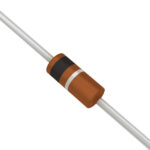 BAV18-TR
The activity of extra discounts on wholesale prices is in full swing…
Please fill in your contact information and we will send you the latest wholesale price list.






