 ChipApex | Global Electronic Components Supplier
SEARCH
Search Product
Search Post
— IC芯片 | 连接器 | 传感器 | 被动器件 —
Search productSearch post
— IC芯片 | 连接器 | 传感器 | 被动器件 —
Consult the customer manager about the wholesale price.
consultation hotline:86-132-6715-2157
email:[email protected]
Contact the product manager for consultation. One-stop consultation is available.
Do you want a lower wholesale price? Please send us your inquiry and we will reply immediately.
The BAV19 is a superfast recovery rectifier diode manufactured by Diotec Semiconductor. It features an average forward current (IFAV) of 250 mA and a peak forward surge current (IFSM) of 5 A. The device has a maximum repetitive reverse voltage (VRRM) of 650 V. Key electrical characteristics include a forward voltage (VF) of less than 1.0 V at 0.1 A, a leakage current (IR) below 100 nA at 25°C, and a typical junction capacitance of 5 pF. The reverse recovery time (trr) is under 50 ns. Operating temperatures range from -50°C to +200°C for both junction and storage.
Verify the specific package type and marking code against the official Diotec Semiconductor datasheet before ordering. Confirm compliance requirements such as RoHS status directly with the manufacturer or authorized distributor. Ensure that the requested quantity matches standard factory packaging configurations. Cross-reference the part number suffixes to guarantee exact electrical matching for critical circuit designs.
Select this component when circuit design demands fast switching speeds combined with high voltage blocking capabilities. The low junction capacitance makes it suitable for high-frequency signal processing. Evaluate the thermal resistance and ambient temperature conditions to ensure the 200°C junction limit is not exceeded during continuous operation. Compare the 50 ns recovery time against slower alternatives to determine efficiency gains in the target application.
This component belongs to the BAV19 through BAV21 series of superfast recovery rectifier diodes produced by Diotec Semiconductor. These devices are engineered for general-purpose high-speed switching and rectification tasks. The series shares similar structural characteristics but may vary in specific voltage ratings or current handling capacities depending on the exact model designation within the family.
BAV20
The maximum operating junction temperature is +200°C.
The leakage current increases significantly with temperature, rising from less than 100 nA at 25°C to less than 15 µA at 100°C.
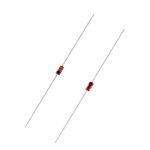 BAV19
BAV19
The activity of extra discounts on wholesale prices is in full swing…
Please fill in your contact information and we will send you the latest wholesale price list.






