 ChipApex | Global Electronic Components Supplier

SEARCH
Search Product
Search Post
— IC芯片 | 连接器 | 传感器 | 被动器件 —
Search productSearch post
— IC芯片 | 连接器 | 传感器 | 被动器件 —
Consult the customer manager about the wholesale price.
consultation hotline:86-132-6715-2157
email:[email protected]
Contact the product manager for consultation. One-stop consultation is available.
Do you want a lower wholesale price? Please send us your inquiry and we will reply immediately.
The BAV70-HE3-18 is a dual switching diode array manufactured by Vishay General Semiconductor - Diodes Division. It features a common cathode configuration housed in an SOT-23 surface-mount package. The device is rated for a maximum repetitive peak reverse voltage of 70V and an average forward rectified current of 250mA. It exhibits a low forward voltage drop and fast switching characteristics, with a maximum reverse recovery time of 4ns. The component operates within a junction temperature range of -55°C to +150°C and complies with RoHS directives.
Verify the specific suffix HE3-18 to confirm the halogen-free status and tape-and-reel packaging format. Ensure compatibility with standard SOT-23 footprints during PCB layout. Confirm that the 70V rating meets the circuit's peak reverse voltage requirements without margin issues. Check for AEC-Q101 qualification if automotive reliability is required, as standard variants may differ.
Select this component when space constraints necessitate an SOT-23 package while requiring dual diode functionality. The common cathode arrangement simplifies biasing compared to separate discrete components. Consider the 250mA current limit for load conditions. The fast recovery time makes it suitable for frequencies where slower general-purpose diodes would introduce significant distortion or delay.
This part belongs to Vishay's BAV series of switching diodes, designed for high-speed applications. The HE3 suffix indicates an eco-friendly compliant version using advanced molding compounds. The -18 suffix typically denotes the specific reel quantity or packaging variant for automated assembly. It serves as a compact alternative to through-hole dual diode packages in modern consumer electronics.
BAV70W-HE3-18: Single diode variant with similar electrical characteristics but different pinout. BAV99-HE3-18: Dual diode with higher current handling capabilities. BAV70M: Plastic encapsulated variant with potentially different thermal performance. Verify pinout compatibility before substituting with non-Vishay equivalents.
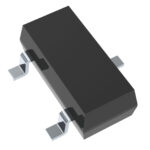 BAV70-HE3-18

The activity of extra discounts on wholesale prices is in full swing…
Please fill in your contact information and we will send you the latest wholesale price list.





