 ChipApex | Global Electronic Components Supplier

SEARCH
Search Product
Search Post
— IC芯片 | 连接器 | 传感器 | 被动器件 —
Search productSearch post
— IC芯片 | 连接器 | 传感器 | 被动器件 —
Consult the customer manager about the wholesale price.
consultation hotline:86-132-6715-2157
email:[email protected]
Contact the product manager for consultation. One-stop consultation is available.
Do you want a lower wholesale price? Please send us your inquiry and we will reply immediately.
The BAV70T116 is a small-signal switching diode manufactured by Rohm Semiconductor, designed for high-speed applications. It features a common cathode configuration within a compact SSD3 (SOT-23) surface-mount package. The device utilizes silicon epitaxial planar construction to ensure reliability and performance. Key electrical characteristics include a maximum reverse voltage of 70V and an average rectified forward current of 0.215A. The component exhibits a typical reverse recovery time of 1.5ns, facilitating efficient operation in ultra-high-speed switching circuits.
Verify the specific ordering suffix T116 to confirm the tape-and-reel packaging format and quantity. Ensure compatibility with standard SOT-23 footprint dimensions during PCB layout. Confirm RoHS compliance status if required by project specifications. Cross-reference the manufacturer's latest datasheet for any updates on supply status or recommended operating conditions before finalizing procurement.
Select this component when a low-cost, high-speed switching solution is required in a minimal footprint. The common cathode arrangement simplifies circuit design compared to discrete diodes. Consider the 70V reverse voltage rating against peak inverse voltages in the target application. Evaluate the thermal dissipation requirements relative to the package's power handling capabilities under continuous operation.
This part belongs to Rohm's family of general-purpose switching diodes, which includes variants like BAW56 and BAV99. These components share similar physical packages but differ in internal circuit configurations such as common anode or common cathode arrangements. The BAV70 series is specifically optimized for speed, distinguishing it from general-purpose rectifier diodes in the same product line.
The BAV70HYT116 serves as a verified substitute with identical pinout and package dimensions. This alternative offers a higher reverse voltage rating of 80V while maintaining similar current handling capabilities. Verify that the increased voltage rating does not impact other circuit constraints before substitution.
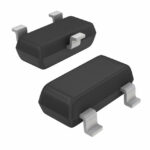 BAV70T116

The activity of extra discounts on wholesale prices is in full swing…
Please fill in your contact information and we will send you the latest wholesale price list.





