 ChipApex | Global Electronic Components Supplier

SEARCH
Search Product
Search Post
— IC芯片 | 连接器 | 传感器 | 被动器件 —
Search productSearch post
— IC芯片 | 连接器 | 传感器 | 被动器件 —
Consult the customer manager about the wholesale price.
consultation hotline:86-132-6715-2157
email:[email protected]
Contact the product manager for consultation. One-stop consultation is available.
Do you want a lower wholesale price? Please send us your inquiry and we will reply immediately.
The BAV99HYFHT116 is a dual series-connected switching diode manufactured by ROHM Semiconductor in an SOT-23-3 surface-mount package. It features a peak reverse voltage of 100 V and an average rectified forward current of 215 mA. The device exhibits a fast recovery time of 4 ns with a maximum forward voltage of 1.25 V at 150 mA and a reverse current of 100 nA. It supports a maximum surge current of 4 A, operates up to +150°C junction temperature, and dissipates 250 mW. This component is qualified under the AEC-Q101 automotive standard.
Verify the specific suffix HT116 against the official ROHM datasheet to confirm reel packaging specifications and tape-and-reel dimensions. Ensure the procurement channel provides traceability documentation required for AEC-Q101 qualified components. Cross-reference the full part number to distinguish from non-automotive variants like BAV99HYT116, as qualification status directly impacts supply chain validation for automotive projects.
Select this component when automotive qualification is mandatory for small-signal switching tasks requiring low capacitance and fast response. The series connection within the SOT-23-3 package offers space efficiency compared to discrete single diodes. Consider the 100 V reverse voltage rating for compatibility with standard automotive power rails. Verify thermal management requirements against the 250 mW power dissipation limit in dense PCB layouts.
This part belongs to ROHM's BAV99H family of low-leakage switching diodes designed specifically for automotive electronics. The HY designation indicates enhanced performance characteristics over standard BAV99 variants, including stricter leakage limits. The HMFH or HYFH suffixes typically denote specific automotive qualification levels and packaging configurations within the broader switching diode portfolio.
BAV99HYT116 shares the same pinout and package but lacks AEC-Q101 automotive qualification. BAV99HMFHT116 is another automotive variant within the same series. Direct substitution requires verifying that the non-HY version meets the specific leakage and reliability requirements of the target application.
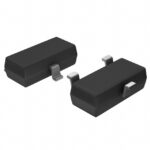 BAV99HYFHT116

The activity of extra discounts on wholesale prices is in full swing…
Please fill in your contact information and we will send you the latest wholesale price list.





