 ChipApex | Global Electronic Components Supplier
SEARCH
Search Product
Search Post
— IC芯片 | 连接器 | 传感器 | 被动器件 —
Search productSearch post
— IC芯片 | 连接器 | 传感器 | 被动器件 —
Consult the customer manager about the wholesale price.
consultation hotline:86-132-6715-2157
email:[email protected]
Contact the product manager for consultation. One-stop consultation is available.
Do you want a lower wholesale price? Please send us your inquiry and we will reply immediately.
The BBY6605WH6327XTSA1 is a silicon tuning diode from the BBY66 series, manufactured by Infineon Technologies. It utilizes an SOT-323 package with a common cathode configuration and features low series inductance of 1.4 nH. The device supports a maximum reverse voltage of 12 V and a forward current of 50 mA. At 1 MHz, capacitance ranges from 66 pF to 71.5 pF at 1 V reverse bias, dropping to approximately 12 pF at 4.5 V. It exhibits a high Q factor, low series resistance (0.25 Ω typical), and very low capacitance spread, making it suitable for low tuning voltage applications.
Verify component authenticity through authorized Infineon channels or certified distributors. Confirm RoHS compliance and AEC-Q101 qualification status prior to integration. Check datasheet revisions for any updates regarding marking layouts or packaging specifications. Ensure storage conditions remain within specified temperature limits to maintain device integrity.
Select this component when a hyperabrupt varactor with tight capacitance tolerance is required for VCO designs. The SOT-323 package suits space-constrained PCB layouts. Verify that the 12 V reverse voltage rating aligns with the circuit's maximum operating voltage. Consider the 1.4 nH series inductance for high-frequency signal paths where parasitic effects must be minimized.
This part belongs to the BBY66 series of silicon tuning diodes, which includes variants like BBY66-02V and BBY66-05. The H6327 suffix indicates specific tape-and-reel packaging and laser marking configurations. The series is engineered for mobile communication devices, emphasizing low voltage operation and high quality factors compared to standard abrupt junction diodes.
Direct substitutes include other hyperabrupt varactors with similar capacitance ratios and package types. Verify pinout compatibility, specifically the common cathode configuration. Ensure replacement parts meet the same AEC-Q101 automotive qualification if used in vehicle electronics. Cross-reference series inductance values to prevent impedance mismatches in RF traces.
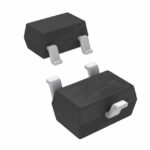 BBY6605WH6327XTSA1
The activity of extra discounts on wholesale prices is in full swing…
Please fill in your contact information and we will send you the latest wholesale price list.





