 ChipApex | Global Electronic Components Supplier
SEARCH
Search Product
Search Post
— IC芯片 | 连接器 | 传感器 | 被动器件 —
Search productSearch post
— IC芯片 | 连接器 | 传感器 | 被动器件 —
Consult the customer manager about the wholesale price.
consultation hotline:86-132-6715-2157
email:[email protected]
Contact the product manager for consultation. One-stop consultation is available.
Do you want a lower wholesale price? Please send us your inquiry and we will reply immediately.
The onsemi BCP54 is a PNP epitaxial silicon power transistor designed for general-purpose switching and amplification applications. It is housed in a SOT-223 surface-mount package, providing robust thermal performance with a maximum power dissipation of 1.5 W. The device features a collector-emitter voltage (VCEO) of -45 V and a continuous collector current (IC) of up to 1 A. Key electrical characteristics include a minimum DC current gain (hFE) of 100 and a transition frequency (fT) of 80 MHz. The component operates within a junction temperature range of -55°C to +150°C, ensuring reliability in demanding environments.
Verify the specific suffix code against the manufacturer's official datasheet to confirm exact binning and electrical tolerances. Ensure the procurement channel provides authentic components with traceable documentation. Check for RoHS compliance status as per the latest regulatory updates. Confirm package type matches the required PCB footprint before ordering.
Select this component when a PNP transistor with high current capacity and surface-mount compatibility is required. Compare hFE ranges and saturation voltages against circuit requirements to ensure adequate drive margins. Consider the thermal resistance of the SOT-223 package relative to the expected power dissipation in the final application layout.
The BCP54 belongs to onsemi's family of complementary power transistors, often paired with NPN counterparts like the BCP53. This series is engineered for cost-effective solutions in consumer electronics and industrial control systems where moderate power handling and reliable switching are critical. The SOT-223 form factor allows for automated assembly while maintaining superior thermal characteristics compared to smaller signal packages.
Direct substitutes may include other PNP transistors in the SOT-223 package with similar VCEO and IC ratings, such as the BCY54 or equivalent parts from other manufacturers. Verify pinout compatibility and thermal specifications before substitution.
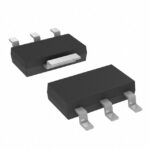 BCP54
BCP54
The activity of extra discounts on wholesale prices is in full swing…
Please fill in your contact information and we will send you the latest wholesale price list.





