 ChipApex | Global Electronic Components Supplier
SEARCH
Search Product
Search Post
— IC芯片 | 连接器 | 传感器 | 被动器件 —
Search productSearch post
— IC芯片 | 连接器 | 传感器 | 被动器件 —
Consult the customer manager about the wholesale price.
consultation hotline:86-132-6715-2157
email:[email protected]
Contact the product manager for consultation. One-stop consultation is available.
Do you want a lower wholesale price? Please send us your inquiry and we will reply immediately.
The onsemi BCP56-10T3G is a discontinued NPN Silicon Epitaxial transistor housed in an SOT-223 package. It features a collector-emitter voltage (VCEO) of 80 Vdc, a continuous collector current (IC) of 1 Adc, and a peak collector current (ICM) of 2 Adc. The device provides a total power dissipation (PD) of 1.5 W at 25°C ambient temperature with a derating factor of 12 mW/°C above this threshold. DC current gain (hFE) ranges from 100 to 160 when tested at IC = 150 mA and VCE = 2.0 V. The unit operates within a junction and storage temperature range of -65 to 150 °C.
Verify component status before design integration as the BCP56-10T3G is officially listed as discontinued by onsemi. Confirm availability through authorized distributors or secondary markets if sourcing is required. Review the manufacturer's guidance regarding new design recommendations for obsolete parts. Ensure compliance with RoHS and Pb-Free packaging standards specified in the datasheet documentation.
Select this component for general-purpose NPN switching and amplification tasks requiring medium power handling in surface mount configurations. Consider the specific hFE binning requirements for linear applications where gain consistency is critical. Evaluate thermal management strategies given the 1.5 W dissipation limit and 83.3 °C/W thermal resistance characteristics in standard PCB mounting scenarios.
This device belongs to the BCP56 Series of NPN silicon epitaxial transistors manufactured by onsemi. The series includes complementary PNP types such as the BCP53T1G. The product line is engineered for audio and power management circuits, offering robust performance in the SOT-223 form factor designed for efficient heat dissipation and reliable surface mounting on printed circuit boards.
Consult onsemi representatives for current alternatives as the BCP56-10T3G is not recommended for new designs. Cross-reference specifications with active series members like the BCP56-16T3G or BCP56T3G, noting that ordering suffixes may indicate different gain bins or packaging quantities rather than functional changes.
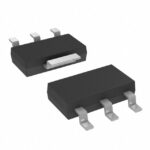 BCP56-10T3G
The activity of extra discounts on wholesale prices is in full swing…
Please fill in your contact information and we will send you the latest wholesale price list.





