 ChipApex | Global Electronic Components Supplier
SEARCH
Search Product
Search Post
— IC芯片 | 连接器 | 传感器 | 被动器件 —
Search productSearch post
— IC芯片 | 连接器 | 传感器 | 被动器件 —
Consult the customer manager about the wholesale price.
consultation hotline:86-132-6715-2157
email:[email protected]
Contact the product manager for consultation. One-stop consultation is available.
Do you want a lower wholesale price? Please send us your inquiry and we will reply immediately.
The BCR141WH6327XTSA1 is an NPN silicon digital transistor from Infineon Technologies, housed in a SOT-323 (SC-70) surface-mount package. It integrates a single NPN transistor with built-in bias resistors of R1=22kΩ and R2=22kΩ. Key electrical parameters include a collector-emitter voltage (VCEO) of 50 V, a continuous collector current (IC) of 100 mA, and a total power dissipation (Ptot) of 250 mW at a case temperature up to 124°C. The device features a transition frequency (fT) of 130 MHz and meets AEC-Q101 automotive qualification standards.
Verify component authenticity through official Infineon channels or authorized distributors. Confirm the specific suffix 'H6327' matches the required tape-and-reel packaging format. Ensure the procurement documentation explicitly states compliance with RoHS lead-free requirements and AEC-Q101 automotive qualification standards before finalizing orders.
Select this component when a compact NPN digital switch with integrated base and emitter resistors is required. The SOT-323 package suits space-constrained designs. Verify that the 50 V collector-emitter voltage and 100 mA current limits align with the target application's load requirements and operating temperatures.
This part belongs to the BCR141 series of NPN silicon digital transistors. The 'W' designation specifically identifies the SOT-323 package variant. Other series members include the F (TSFP-3), S (SOT363), and U (SC74) packages, offering different pin configurations and thermal characteristics for varied layout needs.
Direct replacements within the same family include BCR141F, BCR141S, and BCR141U variants. These share identical electrical characteristics but differ in physical package dimensions and pinout arrangements. Cross-package substitution requires careful verification of footprint compatibility and thermal management constraints.
The BCR141WH6327XTSA1 contains two internal resistors: R1 is 22 kΩ and R2 is 22 kΩ.
Yes, the component is qualified according to the AEC-Q101 standard, making it suitable for automotive electronics.
The maximum junction temperature (Tj) for this device is 150 °C.
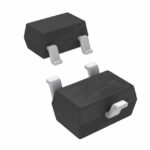 BCR141WH6327XTSA1
The activity of extra discounts on wholesale prices is in full swing…
Please fill in your contact information and we will send you the latest wholesale price list.





