ChipApex | Global Electronic Components Supplier
SEARCH
Search Product
Search Post
— IC芯片 | 连接器 | 传感器 | 被动器件 —
Search productSearch post
— IC芯片 | 连接器 | 传感器 | 被动器件 —
Consult the customer manager about the wholesale price.
consultation hotline:86-132-6715-2157
email:[email protected]
Contact the product manager for consultation. One-stop consultation is available.
Do you want a lower wholesale price? Please send us your inquiry and we will reply immediately.
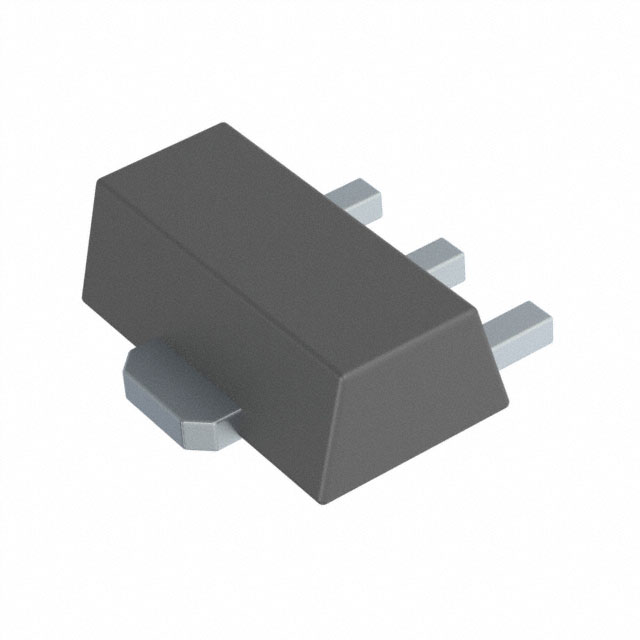
The BCX54-16-QF is an NPN medium power transistor from the Nexperia BCX54-Q series, housed in a SOT89 (SC-62) flat lead Surface-Mounted Device plastic package. It features a collector-emitter voltage of 45 V and a continuous collector current capability of 1 A, with a peak pulse current rating of 2 A. The device offers three current gain selections; the -16 variant specifies a DC current gain range of 100 to 250 at VCE = 2 V and IC = 150 mA. Qualified according to AEC-Q101, it supports high power dissipation up to 1.35 W on a 6 cm² collector pad and operates within a junction temperature range of -55 °C to 150 °C.
Verify the specific ordering suffix matches the required current gain bin, as the BCX54-Q series includes multiple hFE variants such as -Q, -10-Q, and -16-Q. Confirm that the SOT89 package orientation and pinout align with the target PCB footprint design. Ensure thermal management strategies account for the specified power dissipation limits under actual operating ambient temperatures.
Select the BCX54-16-QF when a specific DC current gain range of 100 to 250 is required for circuit stability. Consider the SOT89 package for its exposed die pad if efficient heat transfer to the PCB is necessary. Evaluate the 45 V breakdown voltage against the maximum system supply voltages to ensure adequate safety margins during transient conditions.
This component belongs to the BCX54-Q series of NPN medium power transistors designed for robust performance in demanding environments. The series utilizes a standardized SOT89 package to facilitate surface-mount assembly while providing sufficient thermal conductivity through the exposed collector pad. It serves as a versatile switching and amplification element for both industrial and automotive electronic designs.
BCX54-Q, BCX54-10-Q
The marking code for the BCX54-16-Q type number is BD.
The collector-emitter saturation voltage increases at lower ambient temperatures, such as -55 °C, and decreases at higher temperatures like 100 °C, based on typical characteristic curves.
The transition frequency (fT) is typically 180 MHz when measured at VCE = 5 V, IC = 50 mA, and f = 100 MHz.
 BCX54-16-QF
The activity of extra discounts on wholesale prices is in full swing…
Please fill in your contact information and we will send you the latest wholesale price list.