 ChipApex | Global Electronic Components Supplier
SEARCH
Search Product
Search Post
— IC芯片 | 连接器 | 传感器 | 被动器件 —
Search productSearch post
— IC芯片 | 连接器 | 传感器 | 被动器件 —
Consult the customer manager about the wholesale price.
consultation hotline:86-132-6715-2157
email:[email protected]
Contact the product manager for consultation. One-stop consultation is available.
Do you want a lower wholesale price? Please send us your inquiry and we will reply immediately.
The BD5444EFV-E2 is a Class-D speaker amplifier designed for flat-panel TVs, delivering 20W+20W stereo or 40W mono BTL output. It operates on a supply voltage of 10V to 27V with an efficiency of 93% at 10W+10W into an 8Ω load. The device features four selectable gains (14, 20, 26, and 32dB) and supports Master/Slave configurations. Packaged in a compact reverse heat radiation HTSSOP-B28, it eliminates the need for external heatsinks up to 40W total output.
Verify component authenticity through authorized ROHM Semiconductor distributors. Confirm datasheet revision status matches project requirements. Ensure ESD handling protocols are followed due to moisture sensitivity. Validate thermal performance against specific PCB layout constraints before finalizing procurement quantities.
Select this amplifier for applications requiring high efficiency and low profile without external heatsinks. Verify gain settings via GAIN0/GAIN1 pins match system requirements. Ensure supply voltage remains within 10V to 27V limits. Check minimum load impedance of 3.6Ω compliance. Consider Master/Slave mode for multi-channel synchronization needs.
The BD5444EFV-E2 belongs to ROHM's Middle Power Class-D Speaker Amplifier series. It is specifically engineered for space-saving and low-power consumption in display devices. The product utilizes advanced Bipolar, CMOS, and DMOS process technology to achieve superior audio performance and thermal management in a small form factor.
No officially confirmed substitute part numbers are documented in the provided source material. Consult ROHM Semiconductor directly for potential obsolescence management or alternative recommendations if this component is no longer recommended for new designs.
Gain is set using the GAIN0 and GAIN1 control pins, offering four selectable options: 14dB, 20dB, 26dB, or 32dB for single-ended output.
The IC includes high-temperature protection, output short protection (to Vcc and Gnd), and under-voltage protection, all of which restore automatically when the fault condition is removed.
Yes, the device supports Master/Slave functionality. One unit can operate as a Master while others act as Slaves, synchronized via the OSC pin.
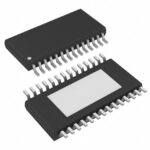 BD5444EFV-E2
The activity of extra discounts on wholesale prices is in full swing…
Please fill in your contact information and we will send you the latest wholesale price list.






