 ChipApex | Global Electronic Components Supplier
SEARCH
Search Product
Search Post
— IC芯片 | 连接器 | 传感器 | 被动器件 —
Search productSearch post
— IC芯片 | 连接器 | 传感器 | 被动器件 —
Consult the customer manager about the wholesale price.
consultation hotline:86-132-6715-2157
email:[email protected]
Contact the product manager for consultation. One-stop consultation is available.
Do you want a lower wholesale price? Please send us your inquiry and we will reply immediately.
The BFR93AW,135 is a silicon NPN ultra-high frequency transistor manufactured by NXP USA Inc., utilizing an N-type epitaxial layer structure housed in a SOT-23 plastic surface-mount package. Key electrical parameters include a collector-emitter voltage of 12V and a maximum collector current of 30mA. The device exhibits a typical transition frequency (fT) of 6GHz at 800MHz, providing a power gain of 14.0dB with a noise figure of 1.6dB. It operates within a junction temperature range of -55°C to +150°C and features a DC current gain (hFE) ranging from 40 to 250 at 30mA.
Verify the specific suffix '135' against official NXP documentation to confirm reel packaging specifications and tape-and-reel dimensions. Ensure compatibility with existing PCB footprints for the SOT-23 package. Cross-reference manufacturing dates and RoHS compliance status directly with the supplier's certificate of conformity prior to integration into production lines.
Select this component when designing circuits requiring high-frequency performance up to 6GHz with minimal signal degradation. Consider the BFT93 as the complementary PNP variant if push-pull configurations are necessary. Evaluate thermal management requirements given the 150°C maximum junction temperature limit and ensure biasing networks support the specified 30mA operating current for optimal noise performance.
The BFR93 series was originally introduced by Philips Semiconductors, now part of NXP, establishing a standard for high-frequency discrete transistors. The AW suffix typically denotes specific marking or packaging variations within the SOT-23 family. This component belongs to a lineage of RF transistors widely adopted in telecommunications infrastructure due to its balance of gain, noise, and power handling capabilities in compact surface-mount formats.
Publicly confirmed substitute part numbers include BFR93A and BFR93R. Verify pinout compatibility and parameter tolerances before substitution. The BFT75R is also listed as a potential replacement in some contexts, though functional equivalence should be validated against specific circuit requirements.
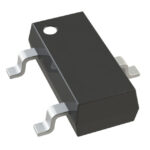 BFR93AW,135
The activity of extra discounts on wholesale prices is in full swing…
Please fill in your contact information and we will send you the latest wholesale price list.





