 ChipApex | Global Electronic Components Supplier

SEARCH
Search Product
Search Post
— IC芯片 | 连接器 | 传感器 | 被动器件 —
Search productSearch post
— IC芯片 | 连接器 | 传感器 | 被动器件 —
Consult the customer manager about the wholesale price.
consultation hotline:86-132-6715-2157
email:[email protected]
Contact the product manager for consultation. One-stop consultation is available.
Do you want a lower wholesale price? Please send us your inquiry and we will reply immediately.
The Bourns BSDH10G120E2 is a silicon carbide Schottky diode rated for 1200 V repetitive peak reverse voltage and 10 A average forward current. It operates within a junction temperature range of -55 °C to +175 °C. The device features a maximum non-repetitive peak forward surge current of 80 A and a total power dissipation of 176.4 W. Electrical characteristics include a typical forward voltage of 1.42 V at 10 A and 25 °C, with a maximum reverse leakage current of 50 µA at 1200 V and 25 °C. The component is housed in a TO220-2 package.
Verify the specific ordering suffix against the manufacturer's official documentation to ensure correct configuration. Confirm that the requested quantity matches the standard packaging specifications provided by Bourns. Check for any recent updates to the datasheet regarding electrical parameters or thermal characteristics before finalizing procurement decisions.
Select this component for high-frequency applications requiring robust transient performance. The TO220-2 package facilitates effective heat dissipation for power levels up to 176.4 W. Ensure the design accounts for the specified thermal resistance values and derating curves to maintain junction temperatures within the safe operating area during continuous operation.
This silicon carbide Schottky diode belongs to Bourns' advanced power component portfolio designed for rectification in high-efficiency systems. The wide bandgap material enables superior performance compared to traditional silicon devices, particularly in high-voltage and high-temperature environments common in modern power electronics.
Consult the official Bourns product selector or technical library for verified equivalent parts. Cross-reference absolute maximum ratings and thermal characteristics to ensure compatibility with existing circuit designs without modifying the PCB layout or cooling infrastructure.
The maximum operating junction temperature is 175 °C.
Yes, the typical recovered charge is 22 nC under specified test conditions.
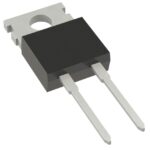 BSDH10G120E2

The activity of extra discounts on wholesale prices is in full swing…
Please fill in your contact information and we will send you the latest wholesale price list.




