 ChipApex | Global Electronic Components Supplier

SEARCH
Search Product
Search Post
— IC芯片 | 连接器 | 传感器 | 被动器件 —
Search productSearch post
— IC芯片 | 连接器 | 传感器 | 被动器件 —
Consult the customer manager about the wholesale price.
consultation hotline:86-132-6715-2157
email:[email protected]
Contact the product manager for consultation. One-stop consultation is available.
Do you want a lower wholesale price? Please send us your inquiry and we will reply immediately.
The BY133 is a standard recovery rectifier diode manufactured by Diotec Semiconductor, housed in the DO-41 axial leaded package. It features a maximum average forward current (IFAV) of 1 A and a peak repetitive reverse voltage (VRRM) of 1300 V. The device exhibits a maximum forward voltage (VF) of 1.3 V at 1 A and a typical reverse recovery time (trr) of 1500 ns. Electrical characteristics include a maximum leakage current of 5 µA at 25°C and 50 µA at 100°C when rated at VRRM. Thermal resistance from junction to ambient is less than 45 K/W, while junction-to-terminal resistance is under 15 K/W. Operating temperatures range from -50°C to +175°C.
Verify component authenticity through official manufacturer channels or authorized distributors. Confirm that the received parts match the specified DO-41 package and 1300V rating. Ensure compliance with relevant environmental standards such as RoHS and REACH as documented in the datasheet. Validate storage conditions to maintain the specified temperature range limits before installation.
Select this component for designs requiring high reverse voltage blocking in a standard axial package. The 1 A current rating and 1500 ns recovery time make it appropriate for low-frequency AC-DC conversion. Consider the thermal resistance values when designing heat dissipation strategies for enclosed environments. Ensure the application does not exceed the maximum surge current ratings during transient events.
This part belongs to the BYX series of standard recovery rectifiers produced by Diotec Semiconductor. It is designed for commercial and industrial grade applications requiring reliable performance in standard operating conditions. The DO-41 package provides a cost-effective solution for through-hole mounting in various electronic assemblies.
Consult the official Diotec documentation for verified substitute part numbers within the same series. Cross-referencing electrical parameters such as voltage, current, and recovery time is essential when evaluating alternative components.
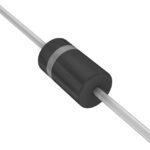 BY133

The activity of extra discounts on wholesale prices is in full swing…
Please fill in your contact information and we will send you the latest wholesale price list.





