 ChipApex | Global Electronic Components Supplier

SEARCH
Search Product
Search Post
— IC芯片 | 连接器 | 传感器 | 被动器件 —
Search productSearch post
— IC芯片 | 连接器 | 传感器 | 被动器件 —
Consult the customer manager about the wholesale price.
consultation hotline:86-132-6715-2157
email:[email protected]
Contact the product manager for consultation. One-stop consultation is available.
Do you want a lower wholesale price? Please send us your inquiry and we will reply immediately.
The BY500-400-E3/54 is a soft recovery fast switching plastic rectifier from Vishay General Semiconductor. It features a maximum repetitive peak reverse voltage of 400 V and a maximum average forward rectified current of 5.0 A. The device exhibits a typical junction capacitance of 28 pF at 4.0 V and 1 MHz, with a maximum reverse recovery time of 200 ns under specified test conditions. It operates within a junction temperature range of -50 to +125 °C and utilizes a DO-201AD package.
Verify the specific suffix /54 indicates delivery in 13-inch diameter paper tape and reel format with a base quantity of 1400 units. Confirm RoHS compliance status as defined by Directive 2011/65/EU. Ensure the component meets JESD 201 class 1A whisker test requirements due to the E3 suffix. Validate that the DO-201AD package dimensions align with your PCB layout constraints before finalizing procurement orders.
Select this component when a 400 V reverse voltage rating is required alongside a 5.0 A continuous forward current capacity. The 200 ns reverse recovery time makes it suitable for medium frequency switching applications where soft recovery characteristics are beneficial. Consider the thermal resistance of 22 °C/W and the operating temperature range up to 125 °C for heat dissipation planning in the target circuit design.
This part belongs to the BY500 series of fast switching plastic rectifiers, which includes variants rated for 100 V, 200 V, 600 V, and 800 V. All series members share identical electrical characteristics except for the maximum repetitive peak reverse voltage. The series is designed for general-purpose rectification in various electronic equipment requiring reliable performance in medium frequency applications.
Direct substitutes include other BY500 series variants such as BY500-100, BY500-200, BY500-600, or BY500-800 if the voltage rating differs. Cross-brand replacements must match the DO-201AD package, 5.0 A current rating, and similar reverse recovery specifications. Verify compatibility with existing PCB footprints and thermal management requirements when substituting.
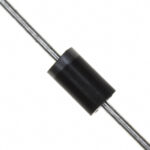 BY500-400-E3/54

The activity of extra discounts on wholesale prices is in full swing…
Please fill in your contact information and we will send you the latest wholesale price list.






