 ChipApex | Global Electronic Components Supplier

SEARCH
Search Product
Search Post
— IC芯片 | 连接器 | 传感器 | 被动器件 —
Search productSearch post
— IC芯片 | 连接器 | 传感器 | 被动器件 —
Consult the customer manager about the wholesale price.
consultation hotline:86-132-6715-2157
email:[email protected]
Contact the product manager for consultation. One-stop consultation is available.
Do you want a lower wholesale price? Please send us your inquiry and we will reply immediately.
The BY520-14E-E3/54 is a glass-passivated junction fast switching rectifier manufactured by Vishay General Semiconductor - Diodes Division. It features a Superectifier structure for high reliability and operates in the DO-41 (DO-204AL) axial through-hole package. The device supports a maximum repetitive peak reverse voltage of 1400 V and an average forward rectified current of 0.5 A. Key electrical characteristics include a peak forward surge current of 20 A, a maximum reverse recovery time of 500 ns, and a maximum instantaneous forward voltage of 2.4 V at 0.5 A. The component has a maximum operating junction temperature of 175 °C.
Verify that the specific part number matches the required 1400 V rating, as the BY520 series also includes variants with different voltage ratings. Confirm compliance requirements such as RoHS status and material categorization definitions before finalizing procurement. Ensure design validation accounts for derating curves and thermal resistance parameters provided in the official datasheet.
Select this component when a fast recovery rectifier with high voltage blocking capability is required in an axial leaded package. Consider the 500 ns reverse recovery time and 175 °C junction temperature limit during circuit design. Validate performance against specific application load conditions using the manufacturer's characteristic curves.
This component belongs to the BY520 series of fast switching rectifiers from Vishay General Semiconductor. The series utilizes the Superectifier technology to provide robust performance in high-voltage environments. The E3 suffix indicates RoHS compliance, while the /54 designation specifies the reel packaging format.
Check for alternative part numbers within the same BY520 series if different voltage ratings are needed. Verify mechanical compatibility with the DO-41 package and ensure electrical parameters meet or exceed original design specifications.
The maximum operating junction temperature is 175 °C.
A color band denotes the cathode end of the diode.
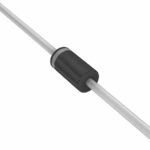 BY520-14E-E3/54

The activity of extra discounts on wholesale prices is in full swing…
Please fill in your contact information and we will send you the latest wholesale price list.






