 ChipApex | Global Electronic Components Supplier
SEARCH
Search Product
Search Post
— IC芯片 | 连接器 | 传感器 | 被动器件 —
Search productSearch post
— IC芯片 | 连接器 | 传感器 | 被动器件 —
Consult the customer manager about the wholesale price.
consultation hotline:86-132-6715-2157
email:[email protected]
Contact the product manager for consultation. One-stop consultation is available.
Do you want a lower wholesale price? Please send us your inquiry and we will reply immediately.
The BYS11-90-M3/TR3 is a surface-mount Schottky barrier rectifier manufactured by Vishay General Semiconductor. It features a single circuit configuration in an SMA (DO-214AC) package. The device has a maximum repetitive peak reverse voltage of 90 V and supports a maximum average forward rectified current of 1.5 A. Peak forward surge current capability is rated at 40 A. The typical instantaneous forward voltage is 750 mV at 1.0 A, with a maximum junction temperature of 150 °C.
Verify the specific ordering suffix to confirm the reel diameter and base quantity. The TR3 designation indicates a 13-inch diameter plastic tape and reel with a base quantity of 7500 units. Confirm that the component meets halogen-free and RoHS compliance requirements as specified for the M3 series. Ensure the application environment remains within the -55 to +150 °C junction temperature range.
Select this component for applications requiring a compact surface-mount Schottky rectifier with low forward voltage drop. The SMA package is suitable for automated placement processes. Consider the thermal resistance characteristics when designing heat dissipation paths. Verify that the 90 V reverse voltage rating exceeds the maximum expected operating voltage in the circuit.
This part belongs to the BYS11 series of surface-mount Schottky barrier rectifiers from Vishay. The M3 suffix denotes a lead-free, halogen-free product compliant with RoHS directives. The device utilizes a guardring technology to improve ruggedness against transient overvoltage events compared to standard structures.
Direct replacements must match the SMA (DO-214AC) package, 90 V reverse voltage, and 1.5 A average forward current ratings. Verify that substitute components offer comparable forward voltage characteristics and thermal performance. Ensure any alternative parts also meet the required MSL level and material categorization standards.
The M3 suffix indicates that the device is halogen-free, RoHS-compliant, and commercial grade. It also signifies that the terminals are matte tin plated and the component meets the JESD 201 class 2 whisker test.
Polarity is identified by a color band on the component body, which denotes the cathode end.
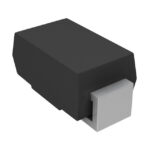 BYS11-90-M3/TR3
The activity of extra discounts on wholesale prices is in full swing…
Please fill in your contact information and we will send you the latest wholesale price list.




