 ChipApex | Global Electronic Components Supplier
SEARCH
Search Product
Search Post
— IC芯片 | 连接器 | 传感器 | 被动器件 —
Search productSearch post
— IC芯片 | 连接器 | 传感器 | 被动器件 —
Consult the customer manager about the wholesale price.
consultation hotline:86-132-6715-2157
email:[email protected]
Contact the product manager for consultation. One-stop consultation is available.
Do you want a lower wholesale price? Please send us your inquiry and we will reply immediately.
The CL2N8-G is a linear constant current LED driver IC manufactured by Microchip Technology. It operates with an input voltage range of 5V to 90V and provides a regulated output current of 20mA. The device supports external dimming control and includes temperature compensation features to maintain stable performance across varying thermal conditions. It is housed in a TO-243AA (SOT-89) surface-mount package, suitable for compact lighting designs requiring efficient regulation.
Verify the specific datasheet revision and environmental compliance status directly from Microchip Technology before procurement. Confirm that the TO-243AA package variant matches your PCB footprint requirements. Ensure input voltage specifications align with your system design to avoid exceeding the 90V maximum rating. Cross-reference part numbers carefully as suffixes may indicate different packaging or environmental grades.
Select this component when a linear topology is acceptable for the application's power dissipation constraints. The 20mA output current is fixed, making it suitable for low-power indicator LEDs or small arrays. Consider the thermal management capabilities of the SOT-89 package relative to the ambient operating temperature. Verify compatibility with external dimming signals if adjustable brightness is required.
This device belongs to Microchip's family of specialized PMIC solutions designed for LED lighting. It integrates essential drive functions into a small form factor, reducing component count compared to discrete solutions. The inclusion of temperature compensation distinguishes it from basic constant current sources, offering improved reliability in thermally variable environments common in consumer and industrial lighting.
Check for direct pin-compatible alternatives within the same product family, such as the CL2N3-G, noting differences in package type (TO-92 vs SOT-89) and specific electrical characteristics. Ensure any substitute maintains the 20mA output current and 90V input voltage limits. Verify that thermal compensation features are present if stability under load variation is critical.
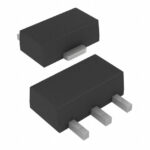 CL2N8-G
The activity of extra discounts on wholesale prices is in full swing…
Please fill in your contact information and we will send you the latest wholesale price list.





