ChipApex | Global Electronic Components Supplier
SEARCH
Search Product
Search Post
— IC芯片 | 连接器 | 传感器 | 被动器件 —
Search productSearch post
— IC芯片 | 连接器 | 传感器 | 被动器件 —
Consult the customer manager about the wholesale price.
consultation hotline:86-132-6715-2157
email:[email protected]
Contact the product manager for consultation. One-stop consultation is available.
Do you want a lower wholesale price? Please send us your inquiry and we will reply immediately.
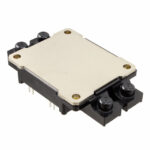
The CM200EXS-34SA is a dual IGBT NX-Series module from Powerex Inc., utilizing 6th Generation Carrier Stored Trench-Gate Bipolar Transistor (CSTBT) silicon technology. It features a collector-emitter voltage rating of 1700 Volts and a continuous collector current capacity of 200 Amperes. The component is housed in the NX-S package, measuring 62mm by 74mm. Designed for high efficiency, it offers approximately a 20% reduction in overall losses compared to the 5th Generation CSTBT and supports a maximum junction temperature of 175 °C.
Verify the specific part number against official manufacturer documentation to ensure compatibility with your design requirements. Confirm that the NX-S package dimensions and pinout align with your thermal management and PCB layout specifications. Cross-reference the electrical ratings with your system's operational parameters to guarantee safe and reliable performance under all expected load conditions.
Select this module when designing circuits requiring 1700V blocking capability and 200A current handling within a compact footprint. Consider the 6th Generation CSTBT technology for applications prioritizing reduced switching and conduction losses. Ensure the external connection method for the chopper diode fits your topology constraints and that the thermal solution can manage heat dissipation at the specified maximum junction temperature.
This component belongs to the 6th Generation NX-Series Choppers line from Powerex Inc. It shares the same NX-S package format as other models in the series, such as the CM150EXS-24S and CM300EXS-24S, but differs in its voltage rating. While similar models operate at 1200V, this variant is specifically rated for 1700V applications, offering a balance between current capacity and voltage withstand capability.
Direct replacements must match the 1700V/200A rating and NX-S package. Verify if alternative modules support the same externally connected diode configuration. Check if the replacement device offers comparable loss characteristics and thermal performance to maintain system efficiency without redesigning the cooling infrastructure.
 CM200EXS-34SA
The activity of extra discounts on wholesale prices is in full swing…
Please fill in your contact information and we will send you the latest wholesale price list.