ChipApex | Global Electronic Components Supplier
SEARCH
Search Product
Search Post
— IC芯片 | 连接器 | 传感器 | 被动器件 —
Search productSearch post
— IC芯片 | 连接器 | 传感器 | 被动器件 —
Consult the customer manager about the wholesale price.
consultation hotline:86-132-6715-2157
email:[email protected]
Contact the product manager for consultation. One-stop consultation is available.
Do you want a lower wholesale price? Please send us your inquiry and we will reply immediately.
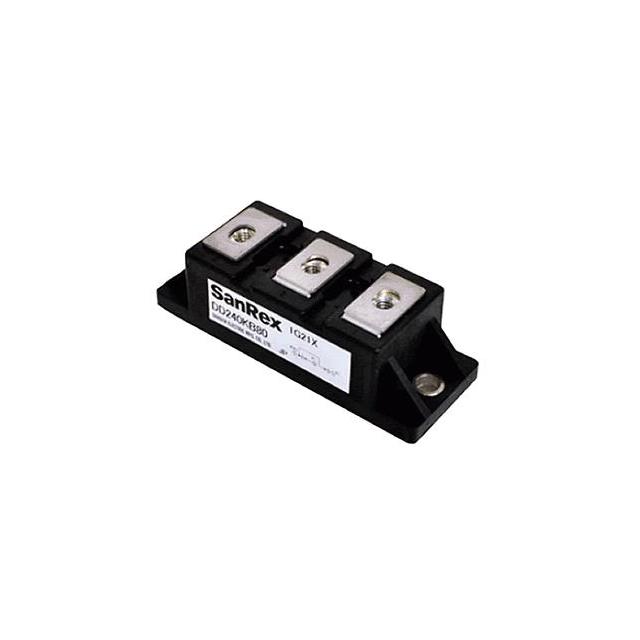
The SanRex DD240KB80 is a silicon power diode module designed for high-current rectification. It features an isolated mounting base and two series-connected diode chips within a single package. The device supports a repetitive peak reverse voltage of 800 V and a non-repetitive peak reverse voltage of 960 V. It provides an average forward current rating of 240 A at Tc=95°C and handles a surge forward current of 5000 A. The maximum forward voltage drop is 1.35 V at 750 A, with a thermal resistance from junction to case of 0.17 °C/W. Operating temperatures range from -40 °C to +150 °C.
Verify the specific part number suffix against official datasheets to confirm voltage ratings, as the DD240KB series includes variants with different blocking voltages. Confirm mounting torque specifications (2.5-3.9 N·m) and isolation voltage requirements (2500 V AC RMS) during integration. Ensure thermal management aligns with the specified junction-to-case thermal resistance and operating temperature limits.
Select this component when a single-phase or three-phase bridge configuration requires an isolated base for thermal management. The 800 V rating suits applications with moderate input voltages. Consider the 240 A continuous current capacity and 5000 A surge capability for load profiles. Verify that the physical dimensions and screw mounting pattern match the mechanical design constraints.
This module belongs to the SanRex DD240KB series, which offers a range of voltage ratings including 400 V, 800 V, 1200 V, and 1600 V. All variants share the same physical footprint and electrical characteristics regarding current handling and thermal performance, differing primarily in their reverse voltage blocking capabilities. The series is engineered for general-purpose industrial rectification.
Direct replacements must match the 800 V reverse voltage, 240 A current rating, and identical mounting dimensions. Verify that substitute components offer comparable surge current ratings and thermal resistance values to ensure system reliability without redesigning the cooling infrastructure.
 DD240KB80
The activity of extra discounts on wholesale prices is in full swing…
Please fill in your contact information and we will send you the latest wholesale price list.