 ChipApex | Global Electronic Components Supplier
SEARCH
Search Product
Search Post
— IC芯片 | 连接器 | 传感器 | 被动器件 —
Search productSearch post
— IC芯片 | 连接器 | 传感器 | 被动器件 —
Consult the customer manager about the wholesale price.
consultation hotline:86-132-6715-2157
email:[email protected]
Contact the product manager for consultation. One-stop consultation is available.
Do you want a lower wholesale price? Please send us your inquiry and we will reply immediately.
The DDTA124XCA-7 is a single PNP pre-biased transistor from Diodes Incorporated, housed in an SOT-23 surface-mount package. It integrates internal biasing resistors with values of R1 = 22 kΩ and R2 = 47 kΩ. The device supports a maximum supply voltage (VCC) of -50 V and a continuous collector current (IC) of -100 mA. Electrical characteristics include a minimum DC current gain (hFE) of 68 and a transition frequency (fT) of 250 MHz. Power dissipation is rated at 200 mW, with an operating temperature range spanning from -55°C to +150°C.
Verify the specific ordering suffix against official documentation to confirm packaging details. The datasheet lists DDTA124XCA-7-F as the standard orderable part number with a 3,000-unit reel quantity. Confirm that the required marking code and tape width align with automated assembly equipment specifications before finalizing procurement orders.
Select this component when a PNP configuration with unequal biasing resistors (R1=22kΩ, R2=47kΩ) is required. Ensure the application voltage does not exceed the -50 V limit and that thermal management accommodates the 200 mW power dissipation rating. Verify compatibility with the SOT-23 footprint during PCB layout.
This component belongs to the DDTA (R1≠R2 Series) CA family of pre-biased transistors. It serves as the PNP counterpart to the DDTC NPN series. The 'CA' designation indicates compliance with specific environmental standards. The device is designed for automated assembly processes using standard SMT techniques.
Direct functional substitutes within the same manufacturer family include DDTA124XCA-7-F. Cross-manufacturer replacements must match the PNP polarity, SOT-23 package, and similar resistor ratios. Verify electrical parameters such as hFE and fT to ensure equivalent performance in the target application.
The DDTA124XCA features an input resistor (R1) of 22 kΩ and a second resistor (R2) of 47 kΩ.
Yes, it has a transition frequency (fT) of 250 MHz, making it suitable for moderate-speed switching and amplification tasks.
The maximum power dissipation (PD) is 200 mW at an ambient temperature of +25°C.
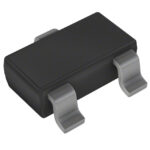 DDTA124XCA-7
The activity of extra discounts on wholesale prices is in full swing…
Please fill in your contact information and we will send you the latest wholesale price list.





