 ChipApex | Global Electronic Components Supplier
SEARCH
Search Product
Search Post
— IC芯片 | 连接器 | 传感器 | 被动器件 —
Search productSearch post
— IC芯片 | 连接器 | 传感器 | 被动器件 —
Consult the customer manager about the wholesale price.
consultation hotline:86-132-6715-2157
email:[email protected]
Contact the product manager for consultation. One-stop consultation is available.
Do you want a lower wholesale price? Please send us your inquiry and we will reply immediately.
The DDTC124GCA-7 is an NPN pre-biased small signal surface mount transistor manufactured by Diodes Incorporated. It features epitaxial planar die construction and integrates a single built-in biasing resistor (R2) with a nominal value of 22 kOhms. The device operates within a collector-emitter voltage range of 50 V and supports a continuous collector current of 100 mA, dissipating up to 200 mW of power. Packaged in a compact SOT-23 case, it provides a minimum DC current gain (hFE) of 56 at 5 mA and 5 V. The component is RoHS compliant, lead-free, and halogen-free, suitable for automated assembly processes.
Verify the specific ordering suffix against official documentation, as variations exist between tape-and-reel formats. Confirm that the required marking code matches the intended production date code requirements. Ensure compliance with environmental directives such as RoHS and REACH if applicable to the target market. Check for any specific manufacturing date code constraints related to molding compound composition.
Select this component when only a single biasing resistor is required for the application. Compare the 22 kOhm R2 value against other series members like DDTC114GCA (10 kOhm) or DDTC144GCA (47 kOhm) to match specific input impedance needs. Consider the complementary PNP type (DDTA124GCA) if a push-pull configuration is necessary. Verify that the SOT-23 package dimensions fit the available PCB space.
This part belongs to the DDTC(R2-only) CA series, which distinguishes itself by including only one internal resistor connected between the emitter and base. Unlike dual-resistor configurations, this design simplifies the external component count while providing basic bias stability. The 'CA' designation indicates the specific pinout and electrical characteristics defined in datasheet DS30332.
Direct substitutes include other Diodes Incorporated parts from the same series, such as DDTC114GCA-7-F or DDTC144GCA-7-F, provided the different nominal resistor values are acceptable. Cross-manufacturer equivalents should be verified for identical pinouts, voltage ratings, and thermal resistance.
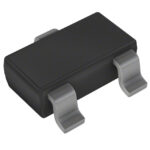 DDTC124GCA-7
The activity of extra discounts on wholesale prices is in full swing…
Please fill in your contact information and we will send you the latest wholesale price list.






