 ChipApex | Global Electronic Components Supplier
SEARCH
Search Product
Search Post
— IC芯片 | 连接器 | 传感器 | 被动器件 —
Search productSearch post
— IC芯片 | 连接器 | 传感器 | 被动器件 —
Consult the customer manager about the wholesale price.
consultation hotline:86-132-6715-2157
email:[email protected]
Contact the product manager for consultation. One-stop consultation is available.
Do you want a lower wholesale price? Please send us your inquiry and we will reply immediately.
The DMMT3906WQ-7-F is a matched pair of PNP small signal transistors manufactured by Diodes Incorporated. It operates with a collector-emitter voltage (VCEO) and collector-base voltage (VCBO) of -40 V, supporting a maximum DC collector current (IC) of -200 mA. The device dissipates up to 200 mW of power and features a transition frequency (fT) of 250 MHz. Packaged in an SOT-363 surface-mount format, it provides intrinsic matching between the two transistors, ensuring a 2% tolerance on current gain (hFE) and a 2 mV difference in base-emitter voltage (VBE).
Verify that the specific part number suffix 'Q' corresponds to the AEC-Q101 qualified automotive grade variant as documented in the manufacturer's ordering information. Confirm that the component meets the required PPAP capability if mandated by the target assembly specifications. Ensure the procurement channel sources directly from authorized distributors to guarantee authenticity and traceability.
Select this component when circuit design requires closely matched PNP transistors within a single package to minimize offset errors. The SOT-363 footprint offers space efficiency compared to discrete components. Verify that the -40 V rating aligns with the system's maximum operating voltages and that the thermal resistance characteristics are sufficient for the intended heat dissipation environment.
This component belongs to the DMMT3906 series of matched pair transistors. While electrically similar to standard commercial variants like the DMMT3906W-7-F, the 'Q' suffix specifically denotes qualification to AEC-Q101 standards. This distinction ensures suitability for automotive environments requiring higher reliability and strict manufacturing process controls without altering the fundamental electrical performance parameters.
Direct substitutes include other AEC-Q101 qualified matched pairs in SOT-363 packages, such as the MMDT3906VC-7-F. When replacing, verify that the replacement maintains the same 2% hFE matching and 2 mV VBE matching tolerances to preserve circuit accuracy.
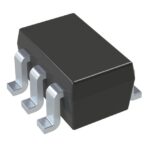 DMMT3906WQ-7-F
The activity of extra discounts on wholesale prices is in full swing…
Please fill in your contact information and we will send you the latest wholesale price list.





