 ChipApex | Global Electronic Components Supplier
SEARCH
Search Product
Search Post
— IC芯片 | 连接器 | 传感器 | 被动器件 —
Search productSearch post
— IC芯片 | 连接器 | 传感器 | 被动器件 —
Consult the customer manager about the wholesale price.
consultation hotline:86-132-6715-2157
email:[email protected]
Contact the product manager for consultation. One-stop consultation is available.
Do you want a lower wholesale price? Please send us your inquiry and we will reply immediately.
The DS1007S-12 is a seven-channel silicon delay line in a 16-pin SOIC package. It provides independent buffered delays with ±2 ns tolerance at room temperature. Supply voltage ranges from 4.75 V to 5.25 V, with active current typically 70 mA. Delays for outputs 1 through 4 are set between 3 ns and 10 ns, while outputs 5 through 7 range from 9 ns to 40 ns. The device operates within a commercial temperature range of 0°C to 70°C and features TTL/CMOS-compatible inputs and outputs.
Verify the specific delay configuration table for the DS1007S-12 suffix against official documentation before procurement. Confirm that the required delay values match the standard or custom specifications provided by Analog Devices. Ensure supply voltage and operating temperature requirements align with the system design constraints.
Select this component when fixed, precise signal delays are required without programmability. Consider the ±2 ns accuracy and unidirectional variation across outputs due to temperature or voltage changes. Verify that the 70 mA active current draw fits the power budget and that the 16-pin SOIC footprint accommodates the PCB layout.
The DS1007 series replaces older hybrid delay technologies with an all-silicon solution for improved reliability and economy. The 'S' suffix indicates the surface-mount 16-pin SOIC package variant. This part belongs to a family where delay times are factory-set based on customer specifications rather than being user-programmable.
No direct public substitute part numbers are confirmed for the DS1007S-12. Custom delay lines generally require matching the specific nanosecond values and package type. Consult Analog Devices for potential obsolescence management or alternative discrete delay solutions if this part is discontinued.
The delay tolerance is ±2 ns at room temperature (25°C).
All output delays in the same speed category tend to vary unidirectionally with temperature or voltage range.
The minimum input pulse width must be 100% of the programmed delay time (tPLH).
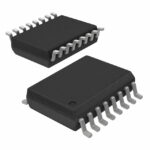 DS1007S-12
The activity of extra discounts on wholesale prices is in full swing…
Please fill in your contact information and we will send you the latest wholesale price list.





