 ChipApex | Global Electronic Components Supplier
SEARCH
Search Product
Search Post
— IC芯片 | 连接器 | 传感器 | 被动器件 —
Search productSearch post
— IC芯片 | 连接器 | 传感器 | 被动器件 —
Consult the customer manager about the wholesale price.
consultation hotline:86-132-6715-2157
email:[email protected]
Contact the product manager for consultation. One-stop consultation is available.
Do you want a lower wholesale price? Please send us your inquiry and we will reply immediately.
The DS2120E/T&R is an Ultra3 LVD SCSI terminator manufactured by Analog Devices Inc./Maxim Integrated. It provides low-voltage differential termination for nine signal line pairs in a 28-pin TSSOP package with tape and reel packaging. The device operates within a temperature range of 0°C to +70°C and requires a supply voltage of 5V. Key electrical parameters include a typical differential mode termination resistance of 110 Ω, common mode termination resistance of 190 Ω, and output capacitance of 3pF. Termpower current ranges from 12mA to 30mA.
Verify the specific ordering suffix to confirm the package type and shipping format. The 'T&R' designation indicates Tape and Reel packaging, while the absence of '+' denotes non-RoHS compliance. Confirm the manufacturer's lead status as this component may be discontinued or subject to limited availability constraints.
Select this component for designs requiring Ultra3 LVD SCSI termination where automatic bus mode detection is necessary. Ensure the design accommodates the 28-pin TSSOP footprint and the required decoupling capacitors for the VREF and TPWR pins. Verify that the system environment remains within the specified 0°C to +70°C operating temperature range.
This part belongs to the DS2120 family of SCSI terminators. It serves as a specialized interface IC designed to manage signal integrity on high-speed SCSI buses. The device simplifies board layout by integrating termination resistors and control logic into a single compact package.
DS2120B/T&R
The device automatically detects Single-Ended (SE) or High-Voltage Differential (HVD) devices via the DIFFSENS line and isolates its termination pins from the bus to prevent interference.
The MSTR/SLV pin selects the master/slave mode for the noncontrolling terminator. When pulled high, it enables the DIFFSENS driver to actively monitor the bus state.
The DIFF_CAP pin connects to an internal digital filter that monitors the DIFFSENS line. It helps eliminate erroneous switching between modes by filtering out high-frequency transients.
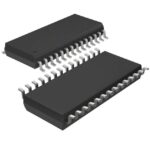 DS2120E/T&R
The activity of extra discounts on wholesale prices is in full swing…
Please fill in your contact information and we will send you the latest wholesale price list.





