 ChipApex | Global Electronic Components Supplier
SEARCH
Search Product
Search Post
— IC芯片 | 连接器 | 传感器 | 被动器件 —
Search productSearch post
— IC芯片 | 连接器 | 传感器 | 被动器件 —
Consult the customer manager about the wholesale price.
consultation hotline:86-132-6715-2157
email:[email protected]
Contact the product manager for consultation. One-stop consultation is available.
Do you want a lower wholesale price? Please send us your inquiry and we will reply immediately.
The DSS4160FDBQ-7 is a dual NPN low saturation transistor manufactured by Diodes Incorporated in the U-DFN2020-6 (Type B) package. It features a collector-emitter breakdown voltage (BVCEO) of 60V and supports a continuous collector current (IC) of 1A. The device exhibits a maximum collector-emitter saturation voltage (VCE(sat)) of 220mV at 1A and an equivalent on-resistance (RCE(sat)) of 240mΩ at 500mA. Power dissipation reaches up to 2.47W with an exposed pad on a large copper area, while thermal resistance (RθJA) drops to 51°C/W under these conditions. Transition frequency (fT) is rated at 175MHz.
Verify component authenticity through authorized distribution channels or direct manufacturer engagement. Confirm that the ordering suffix matches the required reel size and quantity specifications. Ensure compliance with RoHS and halogen-free requirements as defined by the manufacturer's quality definitions. Validate that the intended application environment aligns with the specified operating temperature range and moisture sensitivity levels.
Select this component when a dual NPN configuration with high current handling and low saturation voltage is required in a compact footprint. Consider the U-DFN2020-6 package for space-constrained designs needing improved thermal performance compared to traditional surface mount packages. Evaluate the 60V rating against system voltage requirements and ensure adequate PCB copper area is available to maximize power dissipation capabilities.
This part belongs to the DSS4160 series of dual NPN transistors from Diodes Incorporated. It shares similar electrical characteristics with other variants like the DSS4160TQ-7 but utilizes a different package type optimized for higher power dissipation and lower thermal resistance. The series is designed for general-purpose switching applications requiring robust performance in automotive and industrial environments.
Direct substitutes include the DSS4160FDB-7, which shares identical electrical specifications and packaging. Verify pinout compatibility and thermal characteristics when replacing components. Ensure any alternative parts meet the same AEC-Q101 qualification and automotive change control requirements if used in regulated applications.
The maximum power dissipation is 2.47W when mounted with the collector pad on a 28mm x 28mm (8cm²) 2oz copper area, assuming both dies are active.
Yes, the device is AEC-Q101 qualified, PPAP capable, and manufactured in IATF16949 certified facilities, making it suitable for automotive applications requiring specific change control.
The junction-to-ambient thermal resistance is approximately 40% lower than that of the SOT26 package, providing more efficient heat dissipation for power-demanding applications.
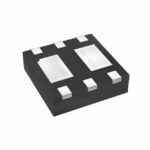 DSS4160FDBQ-7
The activity of extra discounts on wholesale prices is in full swing…
Please fill in your contact information and we will send you the latest wholesale price list.





