 ChipApex | Global Electronic Components Supplier
SEARCH
Search Product
Search Post
— IC芯片 | 连接器 | 传感器 | 被动器件 —
Search productSearch post
— IC芯片 | 连接器 | 传感器 | 被动器件 —
Consult the customer manager about the wholesale price.
consultation hotline:86-132-6715-2157
email:[email protected]
Contact the product manager for consultation. One-stop consultation is available.
Do you want a lower wholesale price? Please send us your inquiry and we will reply immediately.
The DTA113EM3T5G is a single PNP digital transistor (BRT) manufactured by onsemi, housed in an SOT-723 surface-mount package. It integrates internal biasing resistors: R1 is 1 kOhm and R2 is 1 kOhm. The device supports a maximum collector-emitter voltage of 50 V and a continuous collector current of 100 mA. Power dissipation is rated at 260 mW. DC current gain (hFE) is specified as a minimum of 3 at Ic=5mA, Vce=10V. Saturation voltage is max 250mV at Ib=5mA, Ic=10mA. Collector cutoff current is max 500nA. Operating temperature ranges from -55°C to +150°C. It complies with RoHS3 standards.
Verify the complete part number including the suffix T5G to ensure correct tape-and-reel packaging configuration. Confirm RoHS3 compliance status if required by specific environmental regulations. Check datasheet for absolute maximum ratings to prevent overstress during operation. Validate pinout compatibility with existing PCB footprints before finalizing procurement decisions.
Select this PNP variant when negative logic control or high-side switching is required. Compare internal resistor values against other DTA series members to match specific drive current requirements. Ensure the 50V breakdown voltage exceeds the maximum circuit voltage. Consider the SOT-723 thermal characteristics for power dissipation limits in enclosed spaces.
This component belongs to the DTA113 series of pre-biased transistors from onsemi. It is part of a broader family of digital transistors that integrate fixed resistor networks. The EM3 suffix indicates lead-free composition and specific manufacturing traceability. It serves as a direct replacement for older discrete BJT and resistor combinations in legacy designs.
Compatible substitutes include other PNP digital transistors with similar 50V/100mA ratings and SOT-723 packages, such as DTA113 variants from other manufacturers. Verify resistor ratios and hFE gains match original design specifications. Ensure thermal performance and pinout alignment are identical to avoid PCB redesign.
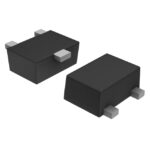 DTA113EM3T5G
The activity of extra discounts on wholesale prices is in full swing…
Please fill in your contact information and we will send you the latest wholesale price list.




