 ChipApex | Global Electronic Components Supplier
SEARCH
Search Product
Search Post
— IC芯片 | 连接器 | 传感器 | 被动器件 —
Search productSearch post
— IC芯片 | 连接器 | 传感器 | 被动器件 —
Consult the customer manager about the wholesale price.
consultation hotline:86-132-6715-2157
email:[email protected]
Contact the product manager for consultation. One-stop consultation is available.
Do you want a lower wholesale price? Please send us your inquiry and we will reply immediately.
The DTA114E is a PNP silicon Bias Resistor Transistor (BRT) designed to replace discrete transistor and resistor networks. It integrates a single PNP transistor with a monolithic bias network comprising a series base resistor and a base-emitter resistor. Key electrical parameters include a supply voltage (VCC) of -50 V, a collector current (IC) of -0.1 A, and an output current of -0.05 A. The device features input resistance R1 and emitter-base resistance R2 both at 10 kΩ. Power dissipation is rated at 0.15 W or 0.2 W depending on the specific manufacturer variant. The DC current gain (hFE) is specified as 30 or more.
Verify the specific manufacturer suffix when ordering, as variants exist from ON Semiconductor, ROHM, and others. Confirm package type compatibility, such as TO-92 for through-hole or SOT-323/SC-70 for surface mount. Check RoHS compliance status and ensure the selected part number matches the required lead-free material specifications for your assembly process.
Select the DTA114E variant based on the required mounting style, distinguishing between through-hole TO-92 packages and surface-mount options like SOT-323. Ensure the -50 V supply voltage and -0.1 A collector current ratings meet the circuit requirements. Verify that the integrated 10 kΩ resistor values align with the desired input impedance and switching characteristics for the specific application design.
The DTA114E belongs to the broader family of digital transistors with built-in resistors, often designated as BRTs. This series is engineered to simplify logic switching and amplification tasks by consolidating multiple components into a single package. Variants may differ in packaging standards, such as JEITA SC-70 or SC-75A, but share the core functional architecture of a pre-biased PNP transistor.
Direct substitutes include other PNP BRTs with identical pinouts and resistor values, such as the MUN2111T1 or DTC114E (NPN complementary). Verify that replacement parts maintain the same -50 V rating and 10 kΩ internal resistance configuration to ensure circuit compatibility without redesign.
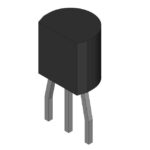 DTA114E
The activity of extra discounts on wholesale prices is in full swing…
Please fill in your contact information and we will send you the latest wholesale price list.





