 ChipApex | Global Electronic Components Supplier
SEARCH
Search Product
Search Post
— IC芯片 | 连接器 | 传感器 | 被动器件 —
Search productSearch post
— IC芯片 | 连接器 | 传感器 | 被动器件 —
Consult the customer manager about the wholesale price.
consultation hotline:86-132-6715-2157
email:[email protected]
Contact the product manager for consultation. One-stop consultation is available.
Do you want a lower wholesale price? Please send us your inquiry and we will reply immediately.
The DTA144EET1G is a PNP Bipolar Digital Transistor (BRT) manufactured by onsemi. It integrates a single transistor with a monolithic bias network comprising two resistors: a series base resistor and a base-emitter resistor. This integration replaces discrete components, simplifying circuit design and reducing board space. Key electrical parameters include a maximum collector-emitter voltage (Vceo) of 50 V, a continuous collector current of 100 mA, and a typical input resistance (R1) of 47 kOhms. The device features a minimum DC current gain (hFE) of 80 and operates within a temperature range of -55°C to +150°C. It is housed in an SC-75 (SOT-416) surface-mount package.
Verify the component authenticity through official onsemi channels or authorized distributors. Confirm the specific ordering suffix matches the required package and tape/reel specifications. Check for RoHS compliance status and ensure the part meets AEC-Q101 requirements if intended for automotive use. Validate the manufacturing date code against project timelines to avoid obsolescence risks.
Select this component when a PNP digital transistor with 50V rating and 100mA current capacity is needed. The 47kOhm input resistance suits standard logic interface applications. Consider the SC-75 package for space-constrained designs. Ensure the operating temperature range aligns with the system environment. Compare with similar BRT devices if different resistor ratios are required.
This part belongs to the DTC/DTA144 series of bipolar digital transistors from onsemi. These devices are designed to simplify switching applications by integrating biasing resistors directly onto the silicon die. The series offers various configurations with different resistor values and polarities (NPN/PNP) to accommodate diverse circuit needs while maintaining a compact footprint.
Compatible substitutes include other PNP BRTs with similar Vceo, Ic, and R1 values from onsemi or other manufacturers. Verify pinout compatibility and thermal characteristics before substitution. Cross-reference datasheets for hFE and saturation voltage differences to ensure circuit performance remains within acceptable limits.
The internal resistors form a bias network consisting of a series base resistor and a base-emitter resistor, eliminating the need for external discrete resistors and simplifying the circuit design.
Yes, the device is AEC-Q101 qualified and supports PPAP capabilities, making it suitable for automotive electronic applications.
The maximum power dissipation is typically rated at 200 mW to 300 mW depending on the specific datasheet version and ambient conditions.
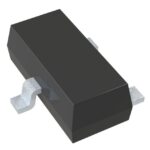 DTA144EET1G
The activity of extra discounts on wholesale prices is in full swing…
Please fill in your contact information and we will send you the latest wholesale price list.






