 ChipApex | Global Electronic Components Supplier
SEARCH
Search Product
Search Post
— IC芯片 | 连接器 | 传感器 | 被动器件 —
Search productSearch post
— IC芯片 | 连接器 | 传感器 | 被动器件 —
Consult the customer manager about the wholesale price.
consultation hotline:86-132-6715-2157
email:[email protected]
Contact the product manager for consultation. One-stop consultation is available.
Do you want a lower wholesale price? Please send us your inquiry and we will reply immediately.
The DTB143EKT146 is a pre-biased PNP digital transistor manufactured by ROHM Semiconductor. It integrates bias resistors within a single SMT3 package to simplify circuit design. Key electrical specifications include a maximum collector-emitter voltage of 50 V and a continuous collector current of 500 mA. The device features a typical input resistance (R1) of 4.7 kOhms and an emitter-base resistance (R2) of 4.7 kOhms, resulting in a resistor ratio of 1. It offers a minimum DC current gain (hFE) of 47 at 50 mA and 5 V, with a transition frequency of 200 MHz. Power dissipation is rated at 200 mW, and the maximum operating temperature reaches +150°C.
Verify component authenticity through authorized distributors or direct manufacturer channels. Confirm RoHS compliance status and check for AEC-Q101 automotive qualification if required for specific reliability standards. Ensure the ordering suffix matches the desired packaging format, such as cut tape or reel, to align with assembly line requirements.
Select this component for designs requiring a PNP digital transistor with integrated biasing. The 4.7 kOhm input resistance suits standard logic interfaces. Consider the 500 mA current capacity and 200 mW power dissipation limits when designing thermal management solutions. Verify that the SMT3 package dimensions fit the available PCB space constraints.
This part belongs to the DTB143EK series of pre-biased transistors from ROHM. It shares functional similarities with other members of the family but differs in polarity and specific resistor values. The SMT3 package provides a small footprint suitable for dense surface mount assemblies. It serves as a discrete alternative to complex driver ICs in low-power switching applications.
Publicly confirmed substitute part numbers are not available in the provided documentation. Cross-referencing requires matching PNP polarity, 50V VCEO, 500mA Ic, and SMT3/SOT-23-3 packaging. Verify internal resistor values and hFE characteristics against the original design requirements before substitution.
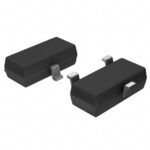 DTB143EKT146
The activity of extra discounts on wholesale prices is in full swing…
Please fill in your contact information and we will send you the latest wholesale price list.





