ChipApex | Global Electronic Components Supplier
SEARCH
Search Product
Search Post
— IC芯片 | 连接器 | 传感器 | 被动器件 —
Search productSearch post
— IC芯片 | 连接器 | 传感器 | 被动器件 —
Consult the customer manager about the wholesale price.
consultation hotline:86-132-6715-2157
email:[email protected]
Contact the product manager for consultation. One-stop consultation is available.
Do you want a lower wholesale price? Please send us your inquiry and we will reply immediately.
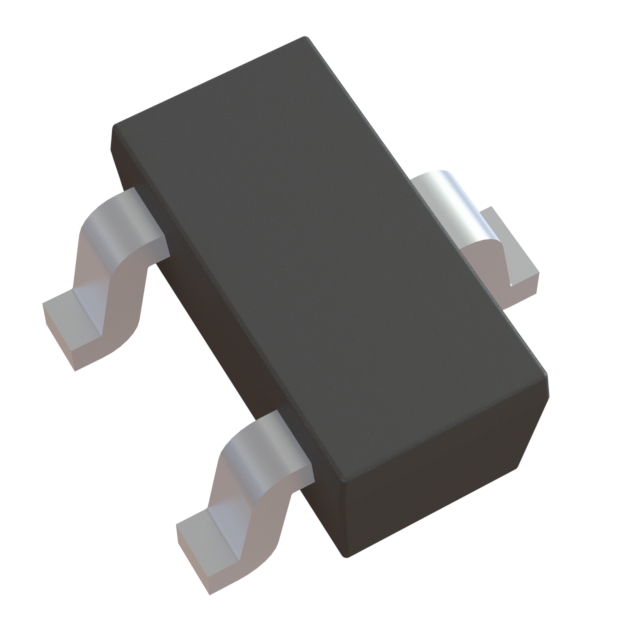
The DTB743EETL is a PNP digital transistor manufactured by Rohm Semiconductor, featuring built-in thin-film bias resistors. It operates with a supply voltage of -30V and a maximum collector current of -200mA. The device incorporates an internal resistance ratio (R2/R1) of 1, with typical R1 and R2 values of 4.7kΩ. Key electrical parameters include a DC current gain (GI) ranging from 115 to 600, a transition frequency (fT) of 260MHz, and a low saturation voltage (VCE(sat)) of -300mV at -50mA/-2.5mA. Power dissipation is rated at 150mW, housed in an EMT3 surface-mount package.
Verify the specific ordering suffix against the manufacturer's documentation to confirm packaging type and quantity. The 'TL' suffix indicates tape and reel packaging with a standard unit quantity of 3000 pieces. Confirm RoHS compliance status and ensure the component meets the required storage temperature range of -55°C to +150°C for your specific application environment.
Select this component when a PNP digital transistor with integrated biasing is required for space-constrained designs. The low saturation voltage makes it suitable for applications demanding efficient switching. Ensure the circuit design accounts for the negative polarity requirements inherent to PNP devices and verify that the 150mW power dissipation rating is sufficient for the intended load conditions.
This part belongs to Rohm's series of low VCE(sat) digital transistors with built-in resistors. It utilizes a PNP epitaxial planar silicon structure. The device is designed for general-purpose electronic equipment and is not intended for radiation-tolerant or high-reliability safety-critical applications such as medical or aerospace systems without additional verification.
Consult the official Rohm datasheet for confirmed substitute part numbers. Verify pinout compatibility and electrical parameter alignment before substitution.
The built-in resistors allow the configuration of an inverter circuit without connecting external input resistors, simplifying the design and eliminating parasitic effects through thin-film isolation.
The transition frequency is 260 MHz, measured at VCE = -10V, IE = 5mA, and f = 100MHz.
No, the product is not designed for use in automotive equipment or systems requiring extremely high reliability where failure may threaten human life.
 DTB743EETL
The activity of extra discounts on wholesale prices is in full swing…
Please fill in your contact information and we will send you the latest wholesale price list.