 ChipApex | Global Electronic Components Supplier
SEARCH
Search Product
Search Post
— IC芯片 | 连接器 | 传感器 | 被动器件 —
Search productSearch post
— IC芯片 | 连接器 | 传感器 | 被动器件 —
Consult the customer manager about the wholesale price.
consultation hotline:86-132-6715-2157
email:[email protected]
Contact the product manager for consultation. One-stop consultation is available.
Do you want a lower wholesale price? Please send us your inquiry and we will reply immediately.
The DTC113EET1G is an NPN Bias Resistor Transistor (BRT) from onsemi, integrating a single transistor with a monolithic bias network consisting of two resistors: a series base resistor (R1) and a base-emitter resistor (R2). Both resistors are specified at 1 kOhm. The device operates with a maximum collector-emitter voltage of 50 Vdc and a continuous collector current of 100 mAdc. It features a DC current gain (hFE) of 3.0 to 5.0 at IC = 5.0 mA and VCE = 10 V. The component is housed in a SC-75 package (Case 463), which measures 1.60 x 0.80 x 0.80 mm. Total device dissipation is rated at 200 mW at TA = 25°C.
Verify the specific ordering suffix to confirm the package type and shipping quantity. The standard DTC113EET1G designation corresponds to the SC-75 package shipped in tape and reel quantities of 3000 units. Confirm RoHS compliance and Pb-free status as indicated by the /C0071 marking. Ensure the application environment does not exceed the maximum ratings for collector-base or collector-emitter voltages.
Select this component when a compact NPN solution with integrated 1 kOhm base and emitter resistors is required. The SC-75 package offers a small footprint suitable for space-constrained designs. Consider the thermal derating characteristics if operating above 25°C ambient temperature. Verify that the required DC current gain and saturation voltage meet the specific load conditions of the target application.
This part belongs to the DTC113EE series of digital transistors manufactured by onsemi. It is functionally related to other parts in the same datasheet such as MUN2230, MMUN2230L, and MUN5230, which share similar internal architectures but may differ in package style or resistor values. The DTC113EET1G specifically utilizes the SC-75 case outline.
Direct replacements within the same family include DTC113EM3T5G, which uses a SOT-723 package. For automotive applications requiring PPAP capability, consider variants with the S or NSV prefix. Verify pinout compatibility and electrical parameters before substituting with other BRT devices.
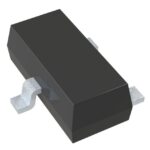 DTC113EET1G
The activity of extra discounts on wholesale prices is in full swing…
Please fill in your contact information and we will send you the latest wholesale price list.





