ChipApex | Global Electronic Components Supplier
SEARCH
Search Product
Search Post
— IC芯片 | 连接器 | 传感器 | 被动器件 —
Search productSearch post
— IC芯片 | 连接器 | 传感器 | 被动器件 —
Consult the customer manager about the wholesale price.
consultation hotline:86-132-6715-2157
email:[email protected]
Contact the product manager for consultation. One-stop consultation is available.
Do you want a lower wholesale price? Please send us your inquiry and we will reply immediately.
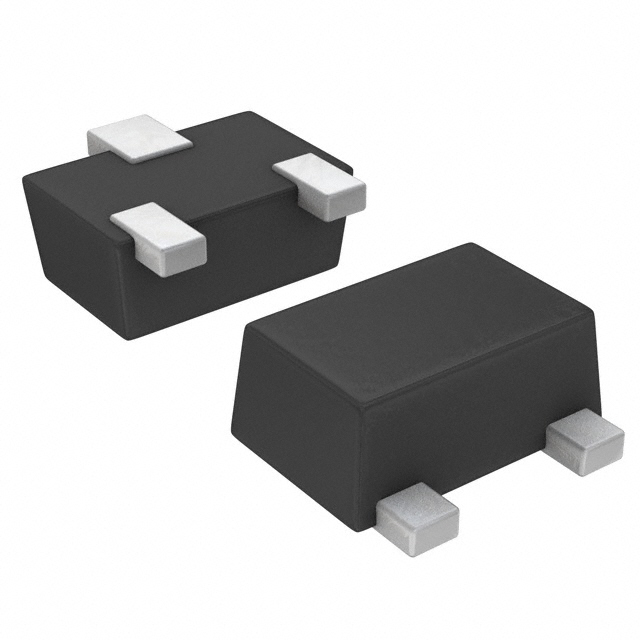
The DTC113ZMT2L is a single NPN pre-biased bipolar junction transistor manufactured by ROHM Semiconductor. It integrates bias resistors within the SOT-723 (VMT3) surface-mount package to simplify circuit design. Key electrical parameters include a collector-emitter voltage of 50 V, continuous collector current of 100 mA, and power dissipation of 150 mW. The device features a typical input resistance of 1 kOhm with a resistor ratio of 10, ensuring a minimum DC current gain of 33 at 5 mA and 5 V. It supports a maximum operating frequency of 250 MHz and operates up to +150°C.
Verify the specific suffix MT2L corresponds to the VMT3 package and tape-and-reel packaging configuration. Confirm RoHS compliance status and lead-free characteristics against the latest manufacturer datasheet. Ensure the application environment does not require automotive qualification, as standard grades may lack AEC-Q101 certification. Cross-reference the part number with official ROHM documentation to confirm availability and production lifecycle status before finalizing procurement plans.
Select this component when a compact NPN switching solution with integrated biasing is required. The 1 kOhm input resistance suits moderate drive levels, while the 50 V rating provides adequate headroom for low-voltage digital systems. Consider the 150 mW power dissipation limit for thermal management in dense PCB layouts. Verify that the 250 MHz frequency response meets the signal speed requirements of the target application.
This device belongs to the DTC113Z series of digital transistors from ROHM Semiconductor. It is the NPN variant of a family that includes complementary PNP types such as the DTA113Z series. The series is characterized by its use of thin-film resistors for improved performance over discrete resistor implementations. The VMT3 package offers a small footprint suitable for space-constrained modern electronics designs.
The typical resistor ratio between the base resistor and emitter-base resistor is 10.
Yes, the integrated thin-film resistors provide complete isolation, allowing for negative biasing off the input.
 DTC113ZMT2L
The activity of extra discounts on wholesale prices is in full swing…
Please fill in your contact information and we will send you the latest wholesale price list.