ChipApex | Global Electronic Components Supplier
SEARCH
Search Product
Search Post
— IC芯片 | 连接器 | 传感器 | 被动器件 —
Search productSearch post
— IC芯片 | 连接器 | 传感器 | 被动器件 —
Consult the customer manager about the wholesale price.
consultation hotline:86-132-6715-2157
email:[email protected]
Contact the product manager for consultation. One-stop consultation is available.
Do you want a lower wholesale price? Please send us your inquiry and we will reply immediately.
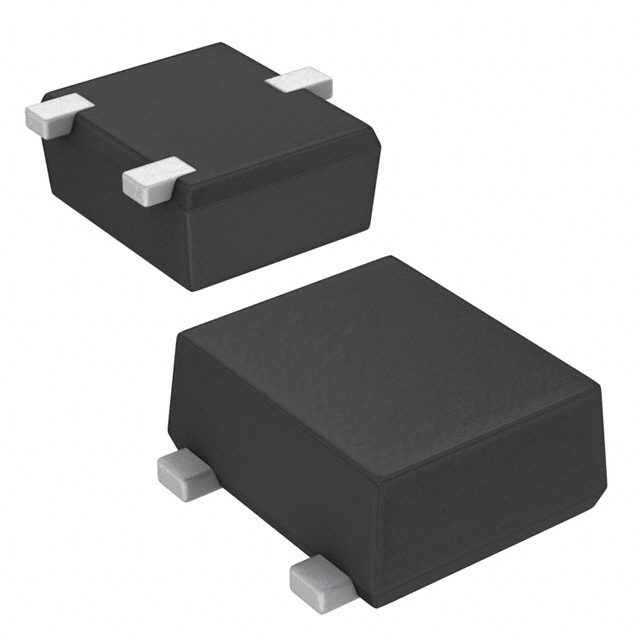
The DTC114YU3HZGT106 is an NPN digital transistor with built-in bias resistors, designed for surface-mount applications in the SOT-323 (UMT3) package. It features a supply voltage of 50V and a maximum collector current of 100mA. The internal circuit includes R1 at 10kΩ and R2 at 47kΩ, providing a resistance ratio of 4.7. Key electrical parameters include a DC current gain (GI) of 68 at 5mA/5V, a transition frequency of 250MHz, and a power dissipation of 200mW. The device is qualified to AEC-Q101 standards for automotive reliability.
Verify the complete part number including the T106 suffix to ensure correct taping specifications and reel quantities. Confirm that the SOT-323 package dimensions align with your PCB footprint requirements. Check for any specific storage time limitations regarding moisture sensitivity before soldering. Ensure compatibility with your assembly process temperatures.
Select this component when a single NPN digital transistor with a 4.7kΩ equivalent base-emitter resistor is required. The 10kΩ input resistance suits standard logic interface levels. Consider the complementary PNP type if negative logic inversion is needed. Verify that the 50V rating meets your circuit's maximum supply voltage constraints.
This part belongs to the DTC114 series of bias resistor built-in transistors from ROHM Semiconductor. It is specifically engineered for compact designs where space savings and simplified biasing networks are critical. The UMT3 package offers a small form factor suitable for dense PCB layouts.
DTC114YUAFRA is a previous generation version with identical pinout and electrical characteristics but is not recommended for new designs. DTC114YU3HZG is the non-taped bulk version of the same component. Ensure substitute parts match the 47kΩ R2 value and SOT-323 package.
R2 is a 47kΩ resistor connected between the emitter and base. It improves switching speed and stability by preventing false triggering due to noise or leakage currents.
Yes, the DTC114YU3HZG series is qualified under the AEC-Q101 standard, making it suitable for automotive electronic applications.
The absolute maximum input voltage (VIN) is specified as -6V to 40V. Exceeding these limits may damage the device.
 DTC114YU3HZGT106
The activity of extra discounts on wholesale prices is in full swing…
Please fill in your contact information and we will send you the latest wholesale price list.