ChipApex | Global Electronic Components Supplier
SEARCH
Search Product
Search Post
— IC芯片 | 连接器 | 传感器 | 被动器件 —
Search productSearch post
— IC芯片 | 连接器 | 传感器 | 被动器件 —
Consult the customer manager about the wholesale price.
consultation hotline:86-132-6715-2157
email:[email protected]
Contact the product manager for consultation. One-stop consultation is available.
Do you want a lower wholesale price? Please send us your inquiry and we will reply immediately.
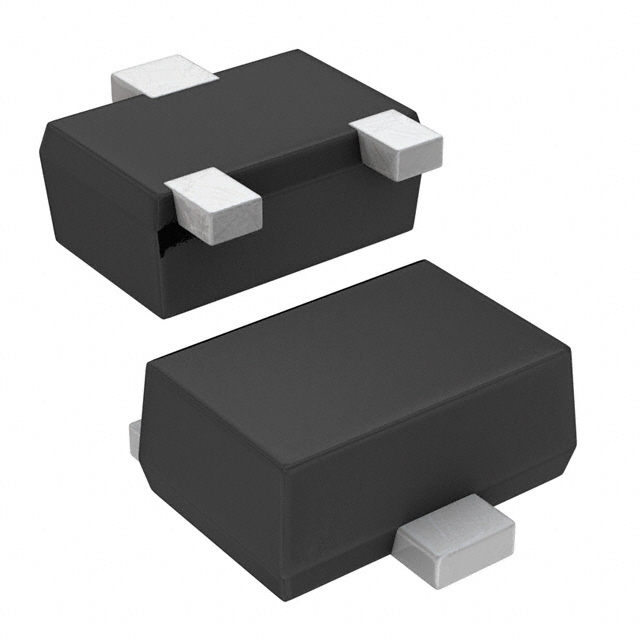
The DTC123JUBTL is an NPN digital transistor manufactured by Rohm Semiconductor, featuring built-in biasing resistors to simplify circuit design. It operates with a collector-emitter voltage of 50 V and a continuous collector current of 100 mA. The device includes an input resistance (R1) of 2.2 kΩ and an emitter-base resistance (R2) of 47 kΩ. Key electrical characteristics include a DC current gain (hFE) of at least 80 at 10 mA and 5 V, and a transition frequency of 250 MHz. Power dissipation is rated at 200 mW. It is housed in a UMT3F (SC-85) surface-mount package.
Verify the complete ordering part number, including suffixes such as TL, TR, or CT, to ensure correct packaging format and tape-and-reel specifications. Confirm RoHS compliance status and check for automotive-grade variants if higher reliability standards are required. Ensure the selected variant matches the specific resistor values and package dimensions needed for the target application design.
Select this component when an NPN pre-biased transistor with 2.2 kΩ base and 47 kΩ emitter resistors is required. Compare against complementary PNP types like the DTA123J series for push-pull configurations. Consider the UMT3F package size constraints and verify that the 200 mW power dissipation rating suits the thermal environment. Check supply status as standard versions may be recommended while others are not.
This component belongs to the DTC123 family of digital transistors from Rohm Semiconductor. Variants within this family share similar electrical characteristics but differ in packaging, such as SOT-323FL or SOT-416, and resistor ratios. The DTC123JUBTL specifically utilizes the UMT3F package, distinguishing it from other pin-compatible or functionally similar parts in the broader product line.
Direct substitutes include other DTC123 series variants with identical pinouts and electrical specs, such as DTC123JU3HZG for automotive applications. Verify compatibility with complementary PNP devices like DTA123JUBHZGTL if both polarities are needed in the design.
 DTC123JUBTL
The activity of extra discounts on wholesale prices is in full swing…
Please fill in your contact information and we will send you the latest wholesale price list.