ChipApex | Global Electronic Components Supplier

SEARCH
Search Product
Search Post
— IC芯片 | 连接器 | 传感器 | 被动器件 —
Search productSearch post
— IC芯片 | 连接器 | 传感器 | 被动器件 —
Consult the customer manager about the wholesale price.
consultation hotline:86-132-6715-2157
email:[email protected]
Contact the product manager for consultation. One-stop consultation is available.
Do you want a lower wholesale price? Please send us your inquiry and we will reply immediately.
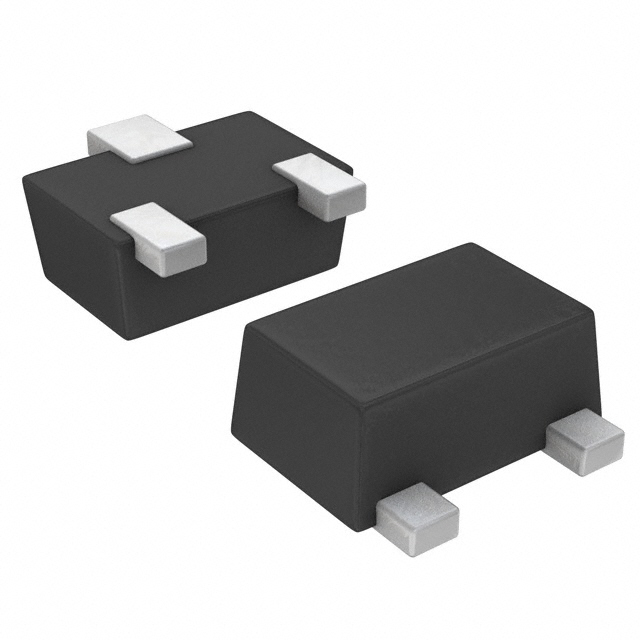
The DTC143EMT2L is a single NPN digital transistor manufactured by ROHM Semiconductor, featuring built-in bias resistors to simplify circuit design. It operates with a supply voltage of up to 50V and supports a continuous collector current of 100mA. The device incorporates two internal resistors, R1 and R2, both typically valued at 4.7kΩ, enabling inverter configuration without external components. Packaged in the compact SOT-723 (VMT3) format, it offers a power dissipation rating of 150mW and a DC current gain (hFE) minimum of 20. The component is designed for surface mount installation and functions within a storage temperature range of -55°C to +150°C.
Verify the specific suffix EM against official ROHM documentation to confirm pinout and electrical characteristics match the target design requirements. Ensure compatibility with standard SOT-723 footprints during PCB layout. Confirm RoHS compliance status through the manufacturer's latest environmental declaration before finalizing procurement orders.
Select this component when a standard NPN digital transistor with equal bias resistors is required. The 4.7kΩ resistor values are suitable for general logic interfacing. Consider the 150mW power dissipation limit and 50V voltage rating to ensure operation remains within safe limits. Verify that the SOT-723 package dimensions fit the available board space constraints.
This part belongs to the DTC143 series of digital transistors from ROHM Semiconductor. The series includes complementary PNP types such as the DTA143E series. The DTC143EMT2L represents a standard-grade product intended for general electronic equipment rather than automotive applications, distinguishing it from higher-reliability automotive-qualified variants in the broader portfolio.
Check for direct substitutes within the DTC143 family or equivalent parts from other manufacturers offering identical 4.7kΩ/4.7kΩ resistor ratios in SOT-723 packages. Verify that any replacement maintains the same hFE minimum and voltage ratings to ensure functional equivalence in existing designs.
 DTC143EMT2L

The activity of extra discounts on wholesale prices is in full swing…
Please fill in your contact information and we will send you the latest wholesale price list.